
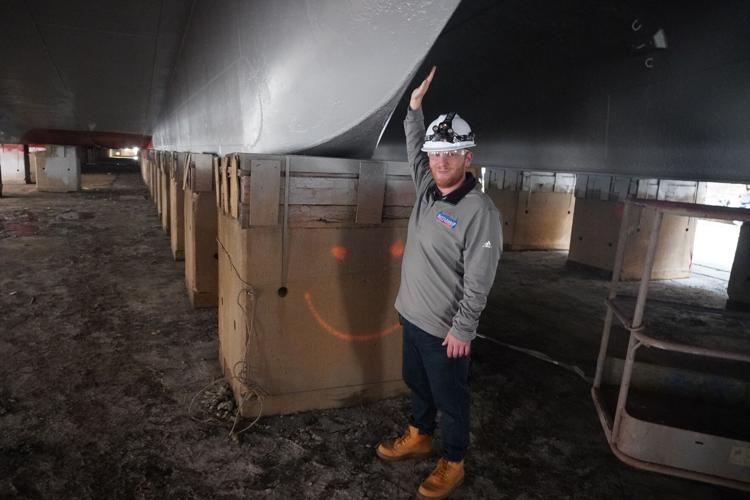


Cherry Hill native Marshall Spevak where few normally go: at the keel of the Battleship New Jersey.
Wearing his steel-toe construction boots and hard hat with mounted light, Marshall Spevak bounded down 77 steps deep into the concrete pit.
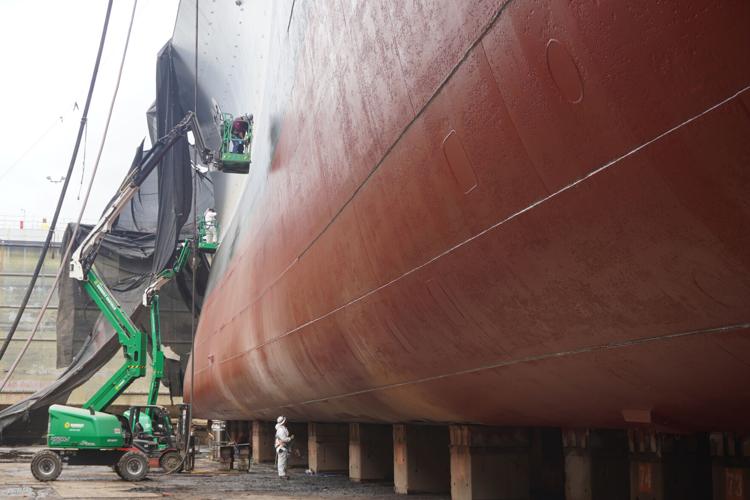
In the pit, resting on 302 concrete blocks, was the 45,000-ton Battleship New Jersey. The sweet, chemical smell of paint filled the air as workers on cranes high above sprayed a coating on the hull to protect the iconic landmark when it returns to Camden in late June to sit again for decades in the Delaware River as a waterfront tourist attraction.
The Cherry Hill native, 35, who gave a reporter an under-ship tour in the Philadelphia Navy Yard dry dock with enthusiasm for the $10-million maintenance project and an obvious love for the battleship, this month was named chief executive officer of the battleship.
His appointment came from the nonprofit Battleship New Jersey Museum & Memorial's Board of Trustees, on which he served since 2016 – with three years as board chair – until he became the interim CEO in March. But the interim turned permanent this month.
It has "really reinvigorated my love and passion for the ship and the team," Spevak said in an interview in the Navy Yard.

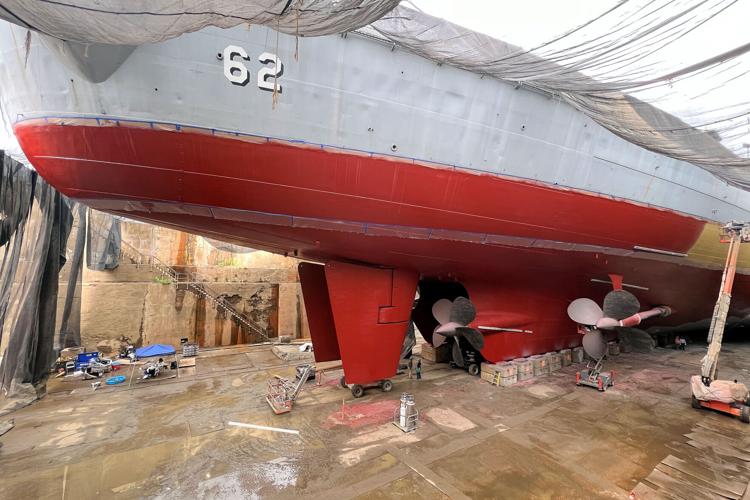
How large is a battleship? If you look closely between the rudder and propeller of the Battleship New Jersey you can see two workers.
The former Trenton lobbyist, Democratic Party worker and chief of staff for state legislators says his new work life is unique.
"I work on a battleship. Who gets to say that?" asked Spevak.
Specifically, the CEO's office is the former ship captain's office, just off the officers' wardroom.
The new CEO spends three to four days a week in Philadelphia at the dry dock.
Spevak, a 2006 Cherry Hill East High School graduate, grew up in the Ramsgate and Sienna neighborhoods in Cherry Hill and now lives in Surrey Place East. He earned his political science degree from Syracuse University.
He is vice-chair of the Township Zoning Board and said he will need to reassess his time commitment devoted to the board. He recently was appointed as co-chair of the Cherry Hill Democrats.

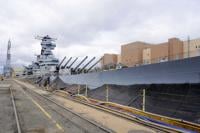
Workers in dry dock have applied several coats of paint to the battleship.
Giving his recent tour to 70and73.com under the battleship, Spevak was armed with fact after fact about the ship's maintenance.
Those 302 blocks, he explained, weigh two tons each and their locations were precisely mapped out on the floor of the pit to carry the mass of the battleship when the water was pumped from the dock and the ship settled after its March 21 trip from Camden's shore.
But won't the hull's hundreds of resting points on the blocks go unpainted and make the ship vulnerable to rust?
Not to worry, Spevak said. The ship will be re-floated in the dry dock, the blocks slightly moved, and the ship will rest again on the blocks. Workers will then paint the bare spots.
Like the car dealer finding extras needing attention when a car owner goes in for an oil change, the ship's maintenance contractor discovered a few issues that were previously unknown.
One of the biggest was 18,000 linear feet of caulk that kept a tight seal between steel plates around the ship's hull. The contractor found the original maker of the caulk and the project was able to order the replacement.
Spevak said the goal is to keep the battleship floating for another 30 years before its next maintenance visit.
Other scheduled maintenance included replacing the ship's cathodic protection system, which used zinc anodes to protect the hull from salt water. Because the river is fresh water, the anodes now are aluminum, which is more effective than zinc in the river.
Workers also had to replace blanks over 164 through-hole openings that normally direct water through the ship, but they need to be blocked when the ship sits at its Camden dock to keep moisture out.
The battleship's staff was surprised by the public reaction to the dry dock tours, which started at $225 per person and climbed to $1,000 for a guided tour led by ship Curator Ryan Szimanski.
"We joked, 'Oh, we could make a million bucks' " by offering dry dock tours, Spevak recalled with a smirk.
The nonprofit was surprised when it sold 6,400 tickets, which has raised more than $1.5 million. Tours on many Saturdays and Sundays were sold out.
Visitors flew in for the tour and many came from other countries for a chance to walk under the battleship, Spevak said.
Dry docking the ship has had an impact on its staff. When in Camden, it normally employs about 20 full-time and about 40 part-time employees. About 30 workers had to be furloughed, but they will return when the ship is pushed by tugboats back into Camden, Spevak said.
The painting and other hull work have not been the only improvements.
A million-dollar project is replacing the event tent on the fantail with a hangar-like event center with a capacity of 400 or more people with lighting, HVAC and audiovisual systems.
Like the tent, the new event center will host weddings, retirement parties, fundraisers and even boxing matches, but it will be more profitable because – unlike the tents that had to be removed in the winter months – the hangar will be available year-round, Spevak explained.
Replacement of the teak deck, started before the dry docking, also will be completed, he said.
Spevak has more ideas to expose the battleship to more people and make its tour even a richer experience.
"I have a whole list of projects that could be done," he said.
The ship has 1,600 compartments and many are still sealed shut. Spevak said more of those spaces could be added to tours, including deeper visits to the engine room and engineering areas.
For the Battleship New Jersey, the visit to the Philadelphia Navy Yard was a homecoming: the ship was built there in 1940-43 for World War II. The ship was later restored as a museum by the Navy Yard beginning in 1999 and opened for public tours on Camden's waterfront in 2001.
The move of the Battleship New Jersey to dry dock has been featured in the national media and has lit up social media platforms.
That, in turn, has generated interest with visitors wanting to take tours in July, August and September, Spevak said.
"I think we're in store for a really big summer."

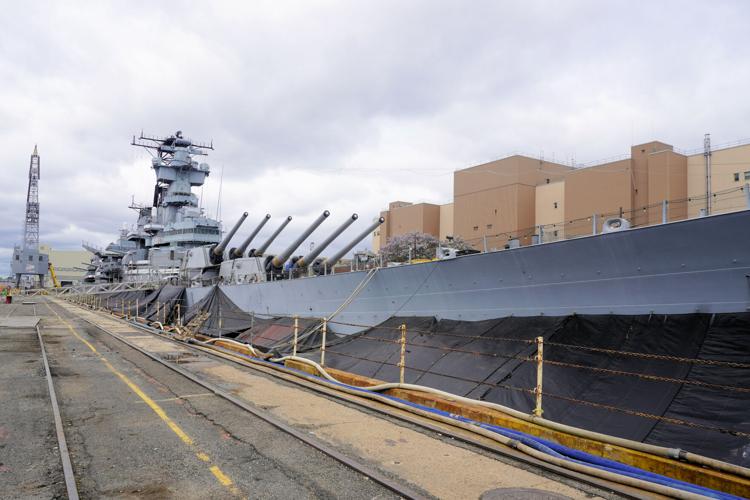
The Battleship New Jersey out of the water in the Philadelphia Navy Yard.

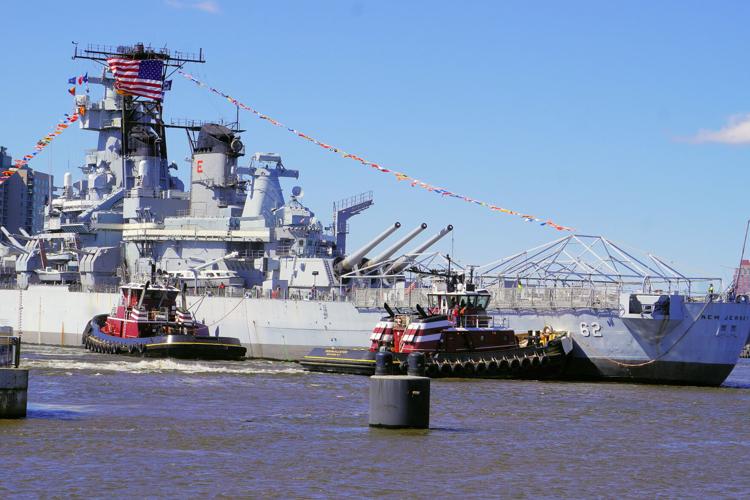
The port side of the Battleship New Jersey, which faced Philadelphia for more than 20 years, faces Camden as the ship in late March was pushed south on the Delaware River for the trip to drydocking at the Philadelphia Navy Yard.


