
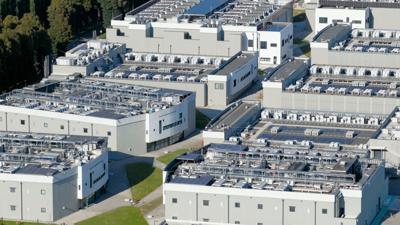

Example of a data center.
Echoing sentiments in many communities about power-hungry data centers, Cherry Hill Mayor David Fleisher says center developers shouldn't even think of his town.
It's not that anyone has proposed an AI or other data center in Cherry Hill's already deeply developed 24 square miles.
"Not yet, and we want to keep it that way," the mayor told us in an interview. He noted that Township lawyers are at work on a formal ban.
"Cherry Hill will not be the guinea pig," Fleisher said. "We know that the technology is evolving, but my opinion is Cherry Hill does not need to be a testing ground."
Lucy Harper of New Jersey State House News Service contributed to this story.
More than 80 data centers are already in operation in New Jersey, according to South Jersey Climate News and more than 4,328 data centers are operating in the U.S., according to the Data Center Map.
The giant data centers, which also have huge needs for water for cooling, could have been a hot real estate trend, but government officials across the nation have applied the brakes.
Millville, in Cumberland County, with nearly twice as many square miles as Cherry Hill, formally banned the data centers last month.
The city's new law offers this rationale: "Operation of large-scale data centers and similar facilities require significant infrastructure demands including but not limited to extremely high electrical power consumption, substantial cooling requirements necessitating excessive water consumption and that the operation of these facilities results in increased noise from the operation of large mechanical equipment, excessive heat generation and environmental impacts resulting from the operation of the equipment, while contributing limited local employment opportunities relative to the land consumption required for these facilities."
Data centers also have captured the attention of legislators.
A bill before the Assembly and passed by the Senate in March requires owners or operators of data centers in New Jersey for three years to report twice annually on consumption of water and energy.
"Upon conclusion of the three-year reporting period, the BPU would be able to make the reporting requirement permanent through the adoption of rules and regulations," the bill states.
The bill was unanimously approved by the Assembly Telecommunications and Utilities Committee, New Jersey State House News Service reported on Friday, noting that an identical measure was passed 34-2 by the Senate in March.
"No one has any idea of how much water this enormous facility is actually going to consume," Anjuli Ramos-Busot, chapter director of the New Jersey Sierra Club said in New Jersey State House News Service's coverage. "Not the DEP (Department of Environmental Protection), the BPU (Board of Public Utilities), not the members of the communities."
Gov. Mikie Sherrill on May 27 disclosed a statewide plan that does not stall or ban the centers, but "will help hold data centers accountable, while positioning New Jersey to lead in AI innovation," according to her announcement.
The New Jersey Pinelands Alliance has called for New Jersey to impose a three-year moratorium on the development of new data centers.
"Many data centers are approved by municipal officials without the expertise or data to evaluate projects with regional impacts on power grids, aquifers and nearby communities," according to the nonprofit environmental advocacy organization.
In Cherry Hill, Mayor Fleisher's distaste for the data centers was sparked by comments of a resident at a May Township Council meeting.
"We're seeing substantial impact from data centers on electricity bills and water supplies," the resident said. "The AI hyperscale data center in Vineland, for example, has been the topic of countless news stories regarding the noise emitted and the massive scale of the project just up the road from people’s housing."


