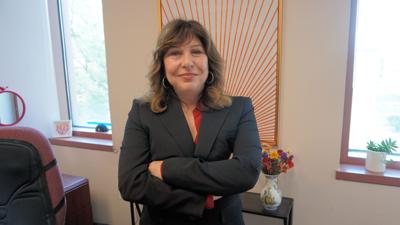


South Jersey resident Krista Nash, in her office at the New Jersey Cannabis Regulatory Commission in Trenton, where she serves as a full-time commissioner.
As she gave a tour of her Trenton workplace, Krista Nash walked through her office doorway and passed an empty nameplate holder mounted on the wall.
Although Nash, who was the first of five full-time members of the New Jersey Cannabis Regulatory Commission, has been on the job for more than a year, the missing nameplate attests to the intense pace of starting a state agency and licensing businesses to sell recreational marijuana to the public.
Is the boom in the state's cannabis industry coming? Yes.
But, Nash told 70and73.com in an interview, that boom has already begun in earnest in the former Department of Environmental Protection offices on East State Street now occupied by the commission.
The commission started up in April 2021 "and truly walked into this office with nothing," said Nash, who added there were no phones, no copiers.
"We truly built this agency," she said. "We have done an enormous amount of work in just over one year."
An ardent animal-rights activist, Nash used to live in Cherry Hill, but moved to a Winslow farm because her 15-year accumulation of rescue animals had grown too large.
The menagerie, tended by Nash and husband Jeff Nash, who has served as a Camden County commissioner for 30 years, now numbers 21, including cats, dogs, ducks and chickens. Nash was born in Atlantic City and grew up in Ocean City.
The only cannabis commission member from South Jersey, Nash makes her daily commute to Trenton where regulations are being written, licenses are reviewed and public comment is researched and considered as the state unit builds itself.
Other members of the commission are Dianna Houenou, chair; Sam Delgado, vice chair; Charles Barker and Maria Del Cid-Kosso. As chair, Houenou is paid $141,000 a year and all other members of the commission are paid $125,000, according to the state's Open Data Center.
By its first 13 months in the middle of May, the commission had adopted 261 pages of rules, began accepting license applications from potential cannabis businesses — from cultivators to retailers — and issued 102 conditional licenses, commission Executive Director Jeff Brown told the state Senate Judiciary Committee on May 12.
"The interest in getting into this industry is tremendous," Brown told Nash and other members at the commission's May 24 monthly meeting. More than 1,000 license applications have been received, he said.
Although recreational marijuana sales began on only a small scale at a limited number of retailers in April, sales from 212,433 transactions totaled $24.2 million between April 21 and May 21, Brown told the commission.
For Nash, serving on the regulatory commission is a natural extension of her work in social work, she said. Gov. Phil Murphy announced her appointment in November 2020 based on the backing of former state Senate President Steve Sweeney.
She received her bachelor's degree in social work from Rutgers University and her master's in social work from the University of Pennsylvania. Before joining the commission, she was director of the PROMISE program of the Volunteers of America Delaware Valley. The program works with the state Parole Board to assist people leaving the criminal justice system who have chronic mental health conditions.
Before decriminalization, marijuana arrests of people of color far outpaced the arrest rate of white people, and that destroys communities and destroys lives, said Nash, who added she had seen this firsthand in her social work career.
"It translates to how I view my role here at the commission," she told 70and73.com. "I have a social work lens when it comes to developing the rules and listening to the people during the public meetings. Really hearing them."
The CREAMM Act — short for the state's Cannabis Regulatory, Enforcement Assistance, and Marketplace Modernization Act — is the "gold standard" of cannabis legalization laws in the nation, Nash said. The act was signed into law by Gov. Murphy in February 2021.
Its social equity focus makes the CREAMM Act a national standout as a marijuana legalization law, she explained.
State residents who have been convicted of marijuana-related offenses rise to the top of the pile of those applying to grow, manufacture, distribute or sell marijuana.
"We look at those first," Nash explained. "We would like to see them get into the market first....There is a lot of goodness in true social equity."
License applications from firms owned by minorities, women and veterans also are a high priority, she said.
"I think we all have a vision of what our hope is what this will look like," Nash said. "It's going to reflect our state, our diversity. Ownership will be residents of New Jersey who may or may not have been impacted by a marijuana-related offense."
Nash expects most of the social-equity businesses that are awarded licenses will be cannabis retailers. Cultivation, for example, has high start-up costs, she said.
»READ MORE: New state rules: What your local recreational marijuana business may look like.
"We review them very, very carefully," she said of the applications, which first are studied by the commission staff and then sent on to the commission members.
She said she is heartened by academic programs cropping up in New Jersey, such as the MBA degree with a concentration in cannabis commercialization that Rowan University's Rohrer College of Business announced in April.
A woman or minority with the Rowan MBA could enter the state's cannabis industry at a high level and would not necessarily need to settle on being an hourly worker, Nash said.
Rowan is not alone in South Jersey preparing students for the fledgling cannabis economy. Stockton University offers a minor in Cannabis Studies.
Nash said the impact on the state's economy will go far beyond the actual cultivation, manufacture and sale of cannabis. She expects businesses serving the new industry, such as advertising and irrigation, also will benefit.
Local municipalities also can benefit because they are permitted to tax the cannabis businesses operating within their borders.
Some in the 70and73 area have adopted ordinances for marijuana sales, including Evesham, Moorestown, Mount Laurel and Voorhees. Others, like Cherry Hill and Medford, have decided — at least for now — not to do so.
Nash acknowledges the stigma surrounding marijuana continues for some state residents.
"It's going to take some time to undo," she said. "Minds can be changed."


