
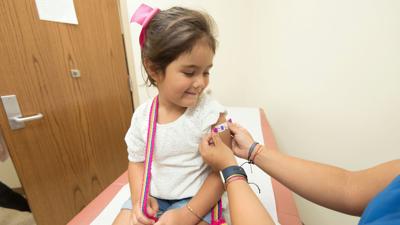

The percentage of New Jersey children who received all state-mandated vaccines last year dropped to its lowest level in recent years.
Little more than 91% of children in childcare or preschool through 6th grade had received all the shots required by the state immunization schedule in the 2024-25 school year, down from more than 95% in 2017-18, according to data from the state Department of Health.
Vaccine coverage was even lower for the youngest children, with fewer than 91% of preschoolers fully immunized, those records showed.
Coverage rates also differed among counties, ranging from 83.2% of all students fully vaccinated in Ocean County to 94.4% in Somerset, but immunization rates have dropped in every county and every grade level. The lowest rate for any group was 79% of children in childcare or preschool in Ocean County.
The declines in vaccination rates are "a troubling trend that, if it continues, will inevitably lead to outbreaks and harm," Linda Schwimmer, president and CEO of the New Jersey Health Care Quality Institute, wrote recently.
This article from NJ Spotlight News was published through the NJ News Commons, a collaborative network of digital news publishers in the state.
New data from the Centers for Disease Control on vaccines among kindergarteners show New Jersey’s coverage rates for five different immunizations exceeded the national average in the last decade. That data also shows a greater percentage of kindergarten-age children in New Jersey with a vaccine exemptions than the nation as a whole.
Between 2017-18 and 2024-25, the number of kindergarten students in New Jersey who were not fully vaccinated increased by some 130% to about 7,500, an NJ Spotlight News analysis of state data found.
Vaccination coverage among kindergarteners declined across the nation for all reported vaccines, the CDC reported. Some 280,000 children throughout the United States attended kindergarten during the last school year without proof of having completed the full MMR vaccination series. As of August 14, there had already been more cases of measles, one of the diseases covered by the MMR vaccine, across the country this year than in all of 2025 – 2,566 so far in 2026 vs. 2,289 in 2025. About 93% of those infected were unvaccinated and 7% of those who contracted measles were hospitalized.
Skepticism about vaccine safety has been growing for years and the appointment of Robert F. Kennedy Jr. to be U.S. secretary of health and human services has continued to fuel the anti-vax movement. A federal effort earlier this year to reduce the number of childhood vaccines was paused by a federal judge after the American Academy of Pediatrics challenged it. President Donald Trump recently signed an executive order seeking to limit vaccines.
New Jersey has its own vaccine schedule that follows the AAP recommendations and not the federal government.
The state does allow for medical exemptions, which have remained consistently below 1% of the population for years, and for religious exemptions, which have been increasing.
Statewide, the percentage of students with religious exemptions doubled between 2017-18 and 2024-25 to 5%. A bill to end religious exemptions in the state passed the Assembly in December 2019 but the Senate canceled a vote on the measure after hundreds of opponents, including parents with children, converged on the State House annex, chanting, praying and banging on the windows.
State officials track vaccinations a number of ways.
The school-vaccine data is reported by childcare providers and school officials each year. The state also collects and reports on vaccination rates among college students and adults
Colleges also report vaccination rates for the MMR, meningococcal disease and Hepatitis B and the state releases an annual report on those results.
More basically, doctors, pharmacies, hospitals and public health officials report vaccines they give through the New Jersey Immunization Information System. Information on individuals’ vaccines is kept confidential.
The state shares broader immunization summary data with the CDC. Both state and federal officials also use data collected from surveys to analyze and report trends.
The Behavioral Risk Factor Surveillance System is a telephone survey of more than 400,000 adults nationwide that collects data about health conditions, health care access, risk behaviors and vaccinations at the state level. In New Jersey, the survey is known as the New Jersey Behavioral Risk Factor Survey.
The CDC also sponsors and oversees the National Immunization Surveys conducted by the University of Chicago. These are phone surveys of vaccine coverage among children and teens and flu and other respiratory illnesses among adults.


