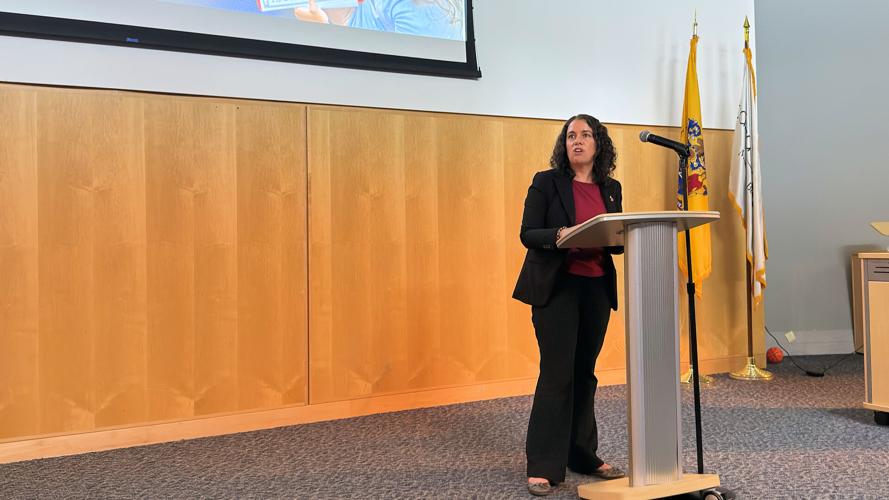
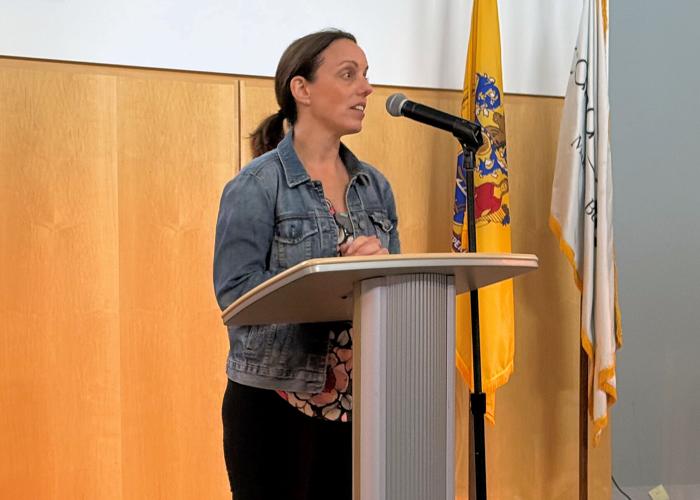
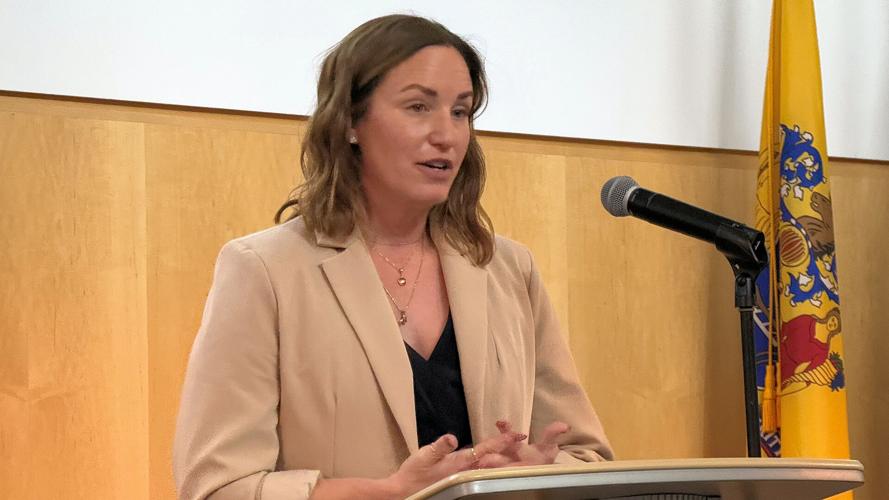
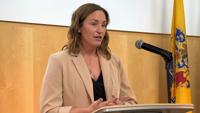

Gina Winters, president of the Cherry Hill Board of Education, addressed the New Jersey School Funding Steering Committee meeting and said Cherry Hill schools have come up short with state education funding under the present system.
Although New Jersey schools are among the nation's best, deep cracks in the funding foundation need immediate repair, said parents, school leaders, teachers and others at a state Department of Education session on Monday.
Overreliance on property taxes and rising costs for health care benefits, transportation and fuel, special education and aging facilities pose serious challenges to the $40 billion spent each year for the state’s 1,398,668 public school students, according to testimony at a New Jersey School Funding Outreach fact-finding session.
At the same time, the state's formula for providing money to individual districts is seriously flawed, the state was told at the session at Camden County College. The session was one of six being conducted across the state.
A perennial issue, the number of school districts in New Jersey, was emphasized by the state in its presentation. The state has 563 operating school districts and 87 charter and renaissance schools. The state illustrated the large number of small districts by noting that total enrollment at the 268 smallest equals the enrollment of the state's three largest.
Education department leaders told the audience the state intends to “make changes ‘down to the studs’” as it redesigns the formula used to send annual state aid to the districts. Reconfiguring the aid formula is expected to take 18 months.
Property taxes are the heart of the problem, state Assembly Majority Leader Louis D. Greenwald (Camden, Burlington counties) told the group.
“New Jersey is the only state in the country that solely funds all of our local governments off property taxes," he said. Programs like property tax rebates and other solutions were created to address the underlying problem of too much focus on property taxes, he said.
Some speakers said using income taxes rather than taxing property for schools would be more equitable.

Jamie Marchese, chair of the Cherry Hill Zone PTA, said the average income measure used in the state formula "doesn't necessarily reflect the financial reality of the families."
Cherry Hill had a large turnout at the event, and several school leaders and residents spoke to the state committee.
Gina Winters, Cherry Hill board of education president, and Jamie Marchese, chair of the Cherry Hill Zone PTA, each said the state funding formula overestimates the wealth of Cherry Hill families, resulting in the district getting less than its fair share.
The formula uses mean household income, derived from aggregate income, to calculate a school district’s wealth. Instead, the formula should use median household income, Winters and Marchese contended.
In 2024, the Census Bureau American Community Survey estimated Cherry Hill’s mean household income was $156,408, which is far higher than the median income estimate of $121,257. The median is viewed as more representative, with half of the households having incomes higher than the median and half having less.

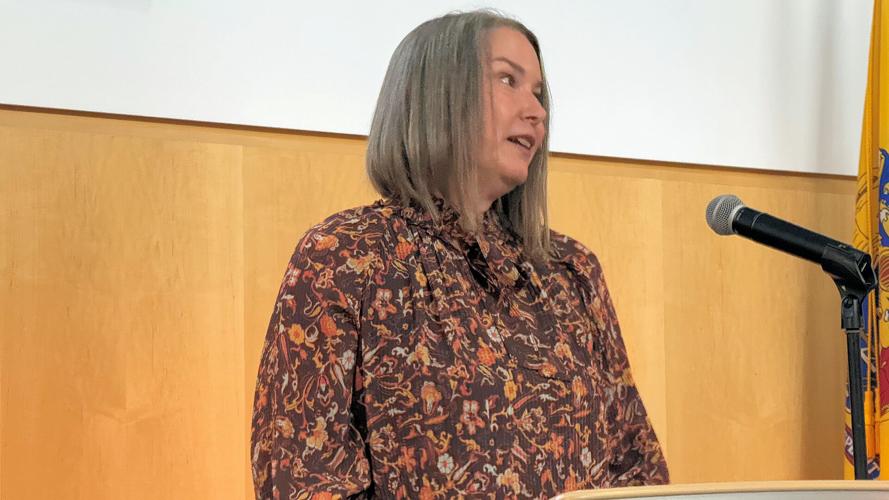
Transportation, special education and staff health care cost increases have outpaced state funding, Kellie Hinkle, president of the Haddon Township school board, told the state group.
Kellie Hinkle, president of the Haddon Township school board, said external costs have slammed her district.
"Transportation, special education and health care costs have climbed far faster than the formula assumes, with no limits on what outside vendors charge," she said.
Hinkle said the state doesn’t actually know what it costs to educate an average student today, let alone one with disabilities or learning English.
“Until we do that work (on the funding formula), every fix, every change, every investment in the formula is effectively a guess," she said.

Surging health care costs have affected the Gloucester City school district, said Sarah Bell, the district business administrator.
Rising health care benefit costs are a particular problem for the Gloucester City school district, said Business Administrator Sarah Bell.
“Forecasts do not indicate these increases are going to improve in the near future,” she said, noting that a $1.4-million health care increase needed to be included in the latest budget.
Marchese, the Cherry Hill PTA officer, said parents want to pay for a quality education.
However, for middle-class New Jerseyans “there is a limit to how much families can reasonably be expected to pay for property tax, particularly when state aid is reduced every year."


