

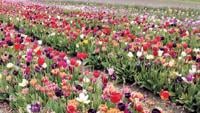



Saddlehill has been selling its tulips by the bouquet and will replant its bulbs for next year. This weekend, May 7-8, Saddlehill will have tulips for sale for Mother's Day at the Promenade at Sagemore on Route 73 in Marlton. Hours are 10 to 3 Saturday and 11 to 3 (or sellout) on Sunday.
Pulling up to the motorized gate on the historic Stafford Farm in Voorhees, owner Bill Green says he usually sees one of his alpacas staring at him and, recently, he has gazed beyond the animals at his 250,000-bulb tulip field in full bloom.
The impact on Green each time he visits, he says, is palpable.
"I've never been happier," Green, 63, told 70and73.com in an interview on Tuesday at the 69.8-acre farm at Evesham and White Horse roads. "That's got to put years on my life."
The entrepreneur/millionaire, who grew up in Marlton (his childhood was spent on Conestoga Drive) and raised his family in Cherry Hill and Voorhees, now lives in Boca Raton, Florida. He thought his relationship with the suburban communities in the future would be when he drove through them, destination elsewhere.
But Green — who made his money in starting and operating a variety of service businesses, a private equity firm in which he invests in other private companies as well as single-family rental homes — bought the nearly 250-year-old, permanently protected Stafford Farm in March 2021 for $900,000 and has immersed himself in its operation. He expects to spend $10 million to $12 million by the project's completion in April 2023.
Green's project, now named Saddlehill, will be a case study in agricultural diversification: primarily a vineyard and winery with year-round restaurant and tasting room, but will also feature a horse-breeding operation and acres devoted to tulips, wildflowers, fruit trees and bushes and, soon to be relocated into the middle of the wildflower field, his nine beehives.
"Bill's purchase of the agricultural portion of Stafford Farm has been a wonderful development for our community," Voorhees Mayor Michael Mignogna told 70and73.com in an email. "He has invested millions of dollars in improving and beautifying the site. It will soon become a community destination."
Saddlehill's wine-making operation, now under construction, and the restaurant/tasting room, ready next spring, will be the centerpiece of the operation, using grapes from the farm's vineyards to produce reds and whites.
Shortly after Green bought the property, he told 70and73.com that he was not sure how deeply to plunge into the food business beyond serving wines.
Since then, he has decided to make that plunge deep and extensive.
The restaurant/tasting room will be 7,000 square feet, with the commercial kitchen occupying 1,500 square feet.
Seating for diners will be throughout: 150 seats inside and 75 seats on the porch, Green explained. Farm-to-table dining fare will be primarily tapas-style small plates, sandwiches, salads, cheeses and appetizers.
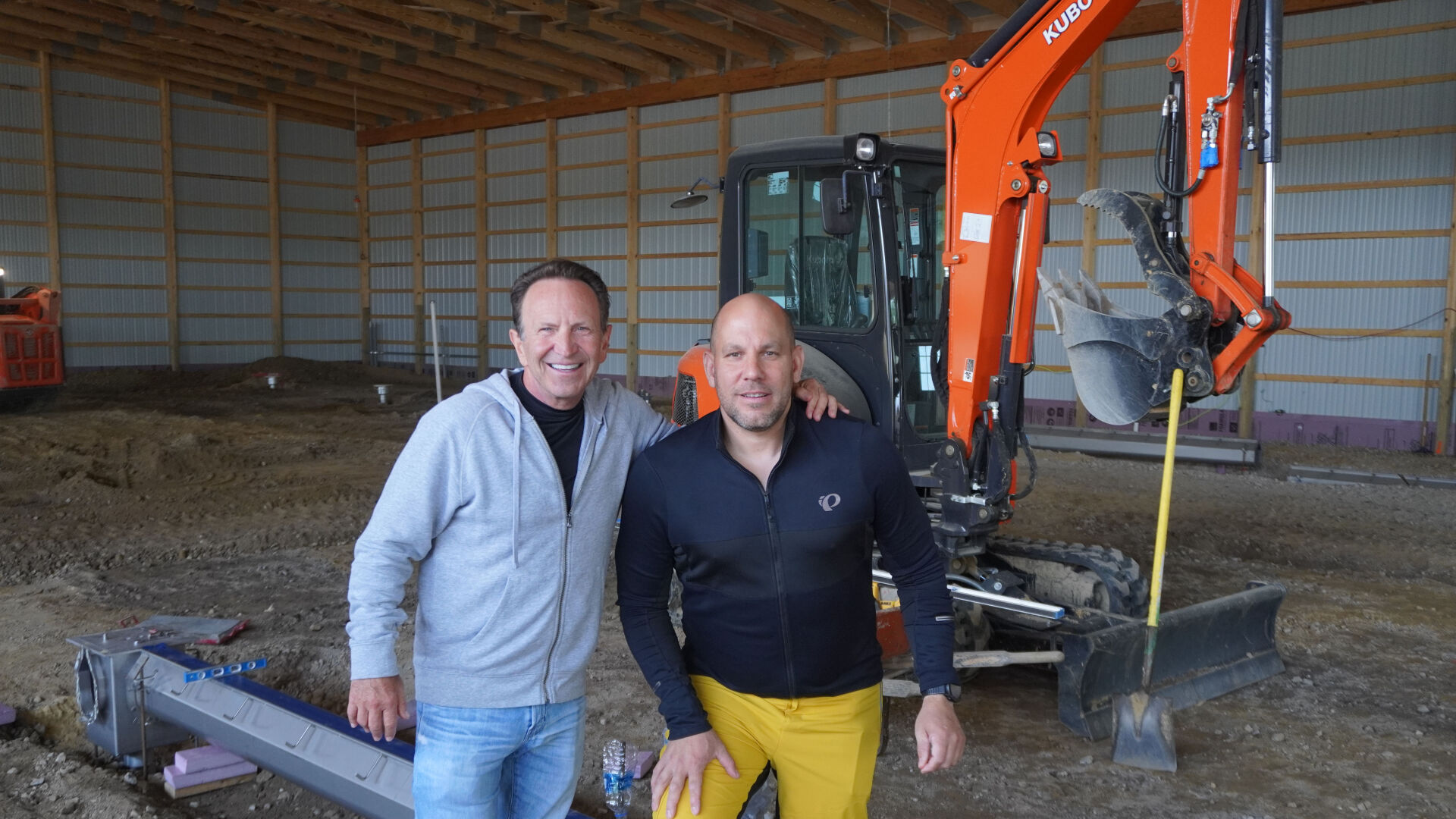
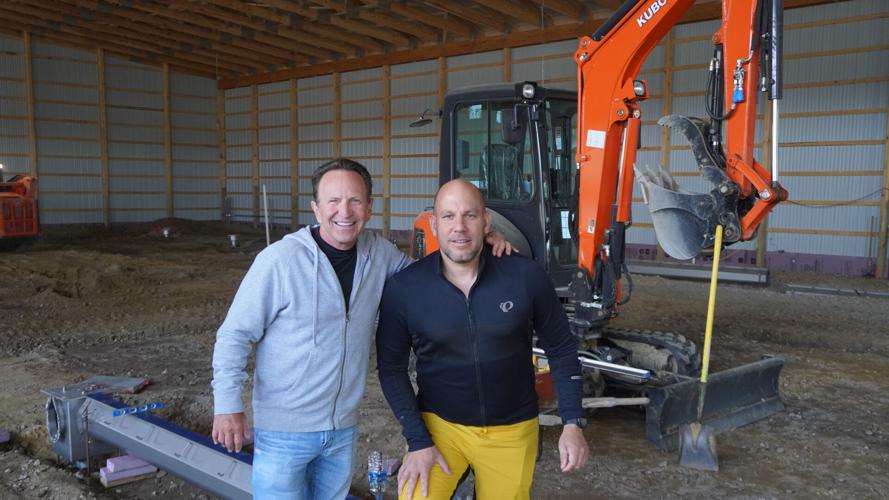
Bill Green, owner of the Saddlehill winery and farm, and winemaker Peter Szerdahelyi, a native of Hungary who has worked at several wineries, including some in California and Australia. They are in the 12,000-square-foot wine manufacturing center, now under construction.
Until recently, Green's missing ingredient in his wine plan was a winemaker to lead the project. He recruited, and got about 125 resumes.
After a dozen Zoom interviews and a few in-person visits, Green hired Peter Szerdahelyi, a native Hungarian who studied oenology, food science and soft-drink production in Budapest. He has worked at wineries in California, Australia and, most recently, in New Hampshire.
Now Szerdahelyi, who lives in Cherry Hill, spends his days supervising the construction of the 12,000-square-foot winery building, which soon will be filled with the stainless-steel piping and tanks and wooden aging barrels critical to any wine-making operation.
Green said the winery's goal is to produce 15,000 cases of wine a year. In the beginning, the goal will be 10,000 cases. He said his mission is to make Saddlehill one of the largest wineries in New Jersey.
As Green drove 70and73.com around the farm on a tour, he explained he does not expect to make an immediate profit, but he does want to identify any way to operate efficiently.
One resource drain, with no productive benefit, is mowing acres of grass on the farm. That is one reason he is covering much of Saddlehill's acreage with vegetation that needs no mowing, including the vineyards (17 acres; 13 red and four white), tulip fields, fruit and berry plants (1.25 acres), wildflowers (two acres) and cover crops.
Green also looks for ways to embellish what otherwise might be routine or mundane, but necessary, parts of the new farming operation. An educational rain garden will be added to a required half-acre water drainage basin behind the brick homestead.
The entrepreneur also said he knows not to try and jump into areas in which he has no knowledge.
One example is the restaurant business. While he has an investment share in several Center City restaurants (Sampan, Double Knot, Alpen Rose and Oyster House), Green is quick to note: "I never ran a restaurant."
Just as he hired a winemaker, Green will be looking for an executive chef with excellent culinary skills and a general manager who will oversee the Saddlehill tasting room and its restaurant operation.
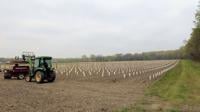
Green's approach to raising grapes for wine is much the same. He contracted with Vinetech, a vineyard management solutions company based in Bridgeton. They do everything for the vineyard, from planting to harvest, except cutting the grass, Green said.
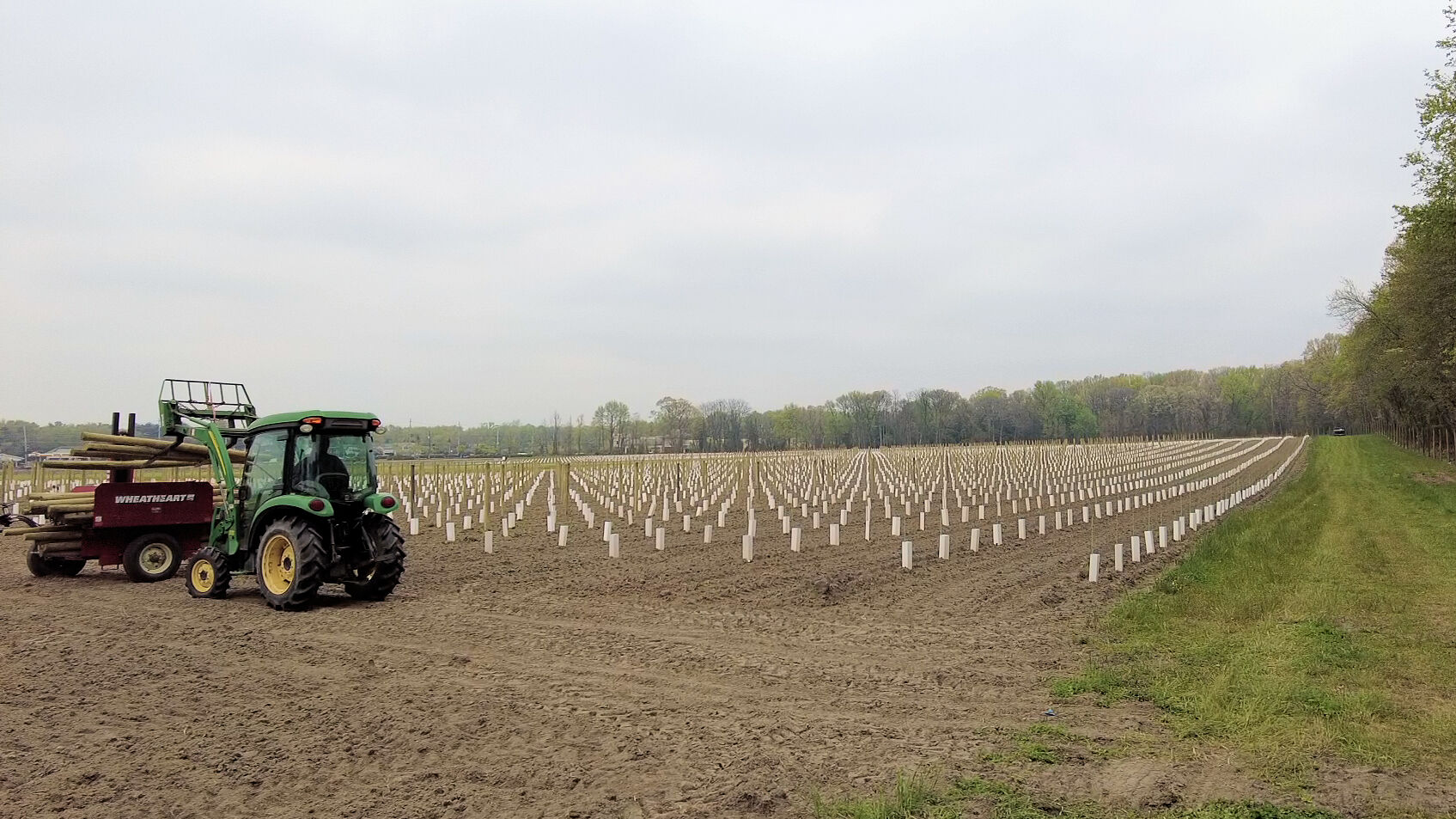
Workers preparing the area around Saddlehill's vineyard. The project contracted with Vinetech, a vineyard management company that handles everything from planting to harvesting.
An 11-stall barn will be built in July and August and a second-floor apartment will house the barn manager. A riding arena will be built near the barn and the existing barn will be demolished.
Horses are the theme of the winery project and Green expects to breed horses on the farm. The operation will not sell foals, but will break and train the horses and sell them — for far more than foals go for — when they are about 3 years old, he explained.
Green has purchased a home on Princeton Drive in the development next to the farm. His backyard borders Saddlehill, so he installed a large gate on the back fence to make access easy when he is staying at the house.
After he agonized and "tossed and turned" over a decision about the dilapidated, 1,300-square-foot brick homestead on the property he decided to renovate rather than demolish.
Both homes will give Green and the families of his three children and five granddaughters a family retreat, of sorts, where they can gather and enjoy the property.
The full Saddlehill project now has nine employees and he expects to have 40 when it is complete.
"This is definitely not about making money," Green said, adding that he would be content to recoup his investment after 10 to 12 years of operating.
And, in not being profit-motivated, Green said he has found joy.
Green said he always has maintained that, as an entrepreneur, he loved business.
Yet, in his later years, he has come to realize this meant loving the concept of being in business and making money. Not until the Saddlehill project has he realized that you can love what you do.
"This is the first time in my life that I can't wait to get here" to the job, Green said.
How did it all get started?
George Washington gave the Voorhees land to his personal guard, Lt. John Stafford, according to a history of the farm at the Saddlehill website. The farm opened about 250 years ago and grew corn and potatoes. Many who grew up in the area — including its current owner — recall horses trotting around the oval at the farm when the Stafford brothers in the 20th Century raised and trained harness racing horses.
Bill Green is the fourth owner. The Stafford family owned it until 2004, when 140 acres were sold to Voorhees Township, the state and a nonprofit for $20.6 million so that the property would remain protected from commercial development. About half of the property was kept by Voorhees Township as open space and half preserved for agriculture and sold in 2005 to Ken and Amy Kazahaya for just over $1 million. They sold to Green in March 2021.


