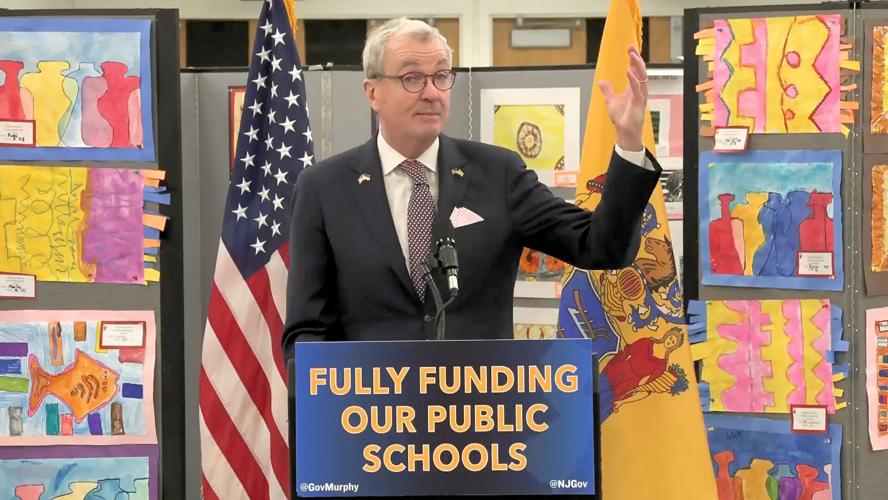
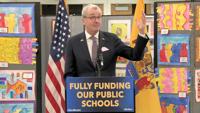

Gov. Phil Murphy said that if the budget gets through the state Legislature it would be the first to fully fund school districts based on their aid formulas. He was speaking Thursday at a Plainfield elementary school.
Since New Jersey’s School Funding Reform Act began in 2009, the state budget each year has failed to allocate the amount needed to fully fund what each school district was due under the state’s aid formula.
But, Gov. Phil Murphy said on Thursday, if his proposed state budget is approved by the state Legislature, every school district will be fully funded in fiscal-year 2025 for the first time.
"Today, with the state aid totals being released…we are taking a historic step forward in serving the needs of every one of New Jersey's schoolchildren," Murphy said in a livecast from a Plainfield elementary school.
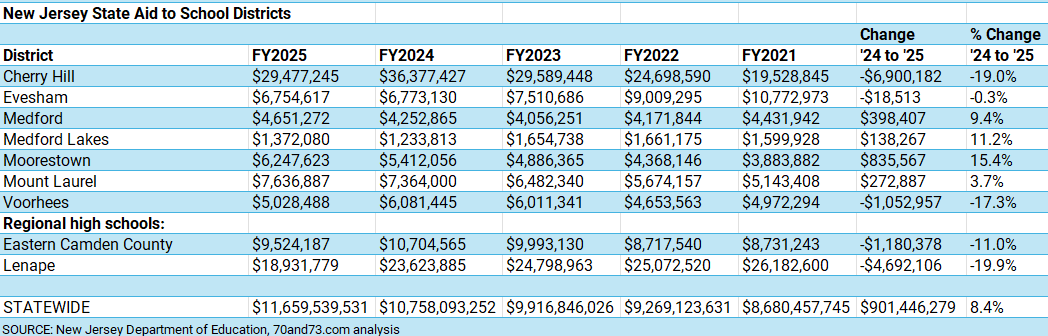
Murphy’s proposed budget calls for nearly $11.66 billion in school aid, an increase of more than $901 million, or 8%, from the current fiscal year, according to state Education Department data.
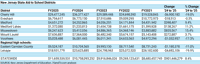
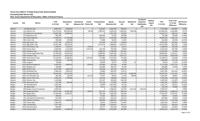
Cherry Hill's share of state aid would be down 19%, or by $6.9 million, in the 2025 round of state aid funding compared with this year's total (see full table below). State aid to the Lenape Regional High School District, the Eastern Camden County Regional School District, Voorhees and Evesham also is slated to decrease in 2025 compared with this year, according to the state data.
In a statement to Cherry Hill residents posted on the Cherry Hill United Facebook page, the school administration and Board of Education said they are working with local and state leaders to find out what is behind the deep cut.
"We are shocked that the state, having increased our aid consistently during the last four years after decades of staggering and harmful underfunding, has cut our aid to less than what we received in 2022-2023," according to the statement. "This decrease in funding is undeserved considering our steady enrollment."
Among all New Jersey school districts, funding would increase for 423, would decrease for 140 and remain flat for 15, according to a 70and73.com analysis of the state data. The average increase would be 6% and the median increase would be 7%.

Speaking at the Plainfield event, Donna M. Chiera, president of the 30,000-member American Federation of Teachers New Jersey, said the "instability of funding" has been a major issue in state education. The union leader, who spent 33 years in the classroom, said a district might get 70% of its fully funded amount one year and 55% the next year.
"You could never put a program in, even if it’s working, and count on it being there for years to come because you never know what comes next," she said.
Although Chiera said she never thought she would see full funding for districts, she also cautioned that it does not stop with one fiscal year’s accomplishment.
"This only works if next year we are standing here and saying for the second year in a row we are fully funded. And in 10 years from now we are still putting education first, and we are saying education is fully funded," she told the group.
Murphy’s budget needs to get through the state Legislature, but several leaders from the Assembly and the state Senate were quoted throughout the governor’s news release praising what fully funding districts means to education in New Jersey.
"By fully funding New Jersey’s schools, we are not only investing in educational excellence, we are also helping to hold down local property taxes," Senator Paul Sarlo (D-Wood-Ridge), chair of the Senate Budget Committee, said in a statement. "Because we managed state finances effectively in recent years we are able to devote resources to the successful completion of the multi-year plan to fully fund the school aid formula. This is good for the schools and the taxpayers."
Murphy said his proposed budget also represents another step toward state funding of free full-day, pre-kindergarten programs for all districts across the state.
The new budget includes funding for 1,000 new "seats" in pre-K for 3- and 4-year-olds statewide.
Full-day, state-funded pre-K saves families tens of thousands of dollars each year, he said. However, because the program now is not offered universally in the state, some families direct their home-buying searches toward districts with the free service, Murphy explained.
"If you can monolithically make New Jersey the state for universal pre-K…there will be nobody who could touch us. It's just another huge magnet to attract families to New Jersey," he said during his Plainfield speech.