

Mount Laurel on Monday night will take aim at several public nuisances with public hearings before the Township Council adopts new restrictions under municipal laws.
Council will go after:
- excessive noise
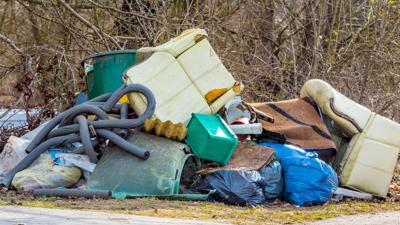
- illegal dumping
- misplaced shopping carts
- contaminated soil
Council is scheduled to meet at 6 p.m. at the municipal building, 750 Centerton Road. The agenda and details of the meeting are here.
Quieting noise
The Township "endeavors to prevent excessive sound that may jeopardize the health, welfare, or safety of the citizens or degrade the quality of life," according to the resolution for the new municipal noise ordinance, which notes it is more stringent than the state law.
"No person shall cause, suffer, allow, or permit the operation of any sound production device in such a manner that the sound crosses a property line and raises the total sound levels above the neighborhood residual sound level by more than the permissible sound level limits," the ordinance states.
Permitted sound levels are detailed in the ordinance. Overall, decibels measured outdoors on residential properties may not exceed 65 decibels from 7 a.m. to 10 p.m. and 50 decibels from 10 p.m. to 7 a.m. On non-residential properties, the maximum is 65 decibels all the time.
A decibel measures the intensity of sound, according to the Federal Aviation Administration. A large business office or a dishwasher running in the next room is equivalent to between 50 and 60 decibels. A vacuum cleaner at 10 feet is equivalent to 70 decibels.
The current law limits noise to 80 decibels, which is classified by the FAA definitions as "noisy urban" and equivalent to a garbage disposal or shouting at a distance of three feet.
The law lists specifics for a range of activities, from yard maintenance to construction.
Noisy animals, such as barking dogs, get their own highly specific section under the ordinance when their noise crosses a property line and interferes with "peace, comfort and repose" of any resident.
Evidence of violating the noise ordinance will include "vocalizing (howling, yelping, barking, squawking etc.) for five (5) minutes without interruption, defined as an average of four or more vocalizations per minute in that period." Or, an average of two "vocalizations" or more per minute for 20 minutes intermittently.
Someone found breaking the law may be required to pay up to a $2,000 fine.
Illegal dumping
Township laws now in effect cover municipal dumps, but that will be replaced by a law prohibiting illegal dumping.
"The use or maintenance of any parcel of land in Mount Laurel for the dumping of garbage, junk, waste matter, toxic and/or hazardous matter is a detriment to public health and is hereby deemed a nuisance," the new law states.
A violation can bring a fine of up to $2,000 and up to 90 days in jail or community service.
Lost shopping carts
"Abandoned shopping carts cause visual blight in neighborhoods, reduce property values in communities, obstruct pedestrian and vehicular traffic in the public rights-of-way, and constitute a hazard to the health, safety and general welfare of the public," according to the new ordinance.
Shopping carts must be labeled by owners, who are responsible for the retrieval of the carts within three business days of being notified by the Township. Failure to collect the lost cart is subject to a fine of $50.
The ordinance also requires retailers with shopping carts to file a "containment" plan with the Township that details how the business avoids having its shopping carts stolen.
Dirty dirt
An amendment to the Township soil removal law notes a soil permit must be secured before anyone removes, imports or exports soil in the Township.
The resolution for the ordinance amendment notes that imported and contaminated soil can create a nuisance for residents.
"If a person imports soil, it must be accompanied by certified soil testing results which state that the soil does not contain harmful material above the standards established by the New Jersey Residential Direct Contact Soil Remediation Standards and New Jersey Non-Residential Direct Contact Soil Remediation Standard," according to the amendment.


