
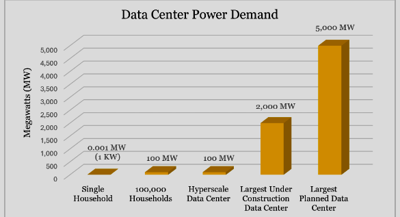
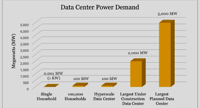

The chart, citing International Energy Agency data, shows how much more power a data center uses than even 100,000 households.
When Cherry Hill prepared to prohibit data centers in its zoning law, Township officials turned to two damning reports that the town commissioned about the large-scale facilities prepared by a New Jersey infrastructure consulting company.
"Due to the documented negative impacts of data centers on water resources, their high demand for energy which often relies on fossil fuels, and their dependence on backup generators that are typically diesel-powered and contribute to air pollution and greenhouse gas emissions, it follows that a data center in Cherry Hill could be inconsistent with these goals of the Master Plan," according to the July 3 report from Christopher N. Dochney of the Camden office of Artheon.
Township Council on Monday unanimously voted in favor of a zoning law amendment that would ban the data centers. The ordinance change will be reviewed by the Planning Board on July 20. Council on July 27 will hold a public hearing on the new law and then decide whether to adopt it.
Mayor David Fleisher has vowed that the centers would not be allowed in Cherry Hill.
Cherry Hill Council introduced zoning law change Monday evening that would ban data centers in town.
Large data centers, controversial across the nation and banned in several New Jersey communities, were born from the growth of AI, cloud computing and other heavy uses of remote computing resources.
"Relative to other land uses of their size and scale, large scale data centers are not typically significant sources of local employment outside of the construction jobs to build the facilities," the Artheon report stated. "They are also not providing goods or services to the local community, but storing or processing data for companies that may be located anywhere."
The report recommended that Cherry Hill more clearly define a data center, differentiating them from warehouses and telecommunications equipment. It notes that the Township Master Plan was written before large data centers were needed.
Artheon suggests that data centers be relegated in the zoning to "noxious and nuisance uses" such as junkyards, airports, quarrying and mining, landfills and waste recovery facilities.
The consultant suggests that a distinction should be made in the law between standalone data centers and businesses with server rooms.
An accessory server room should relate to the operations of the principal use of the property and not used, for example, for cloud computing or digital hosting for third parties, according to the report, which said server room space should be limited to no more than 10% of the gross floor area of the building.
A second Artheon report stated that large data centers are power hogs.
"To meet (the) enormous demand for power, many data centers in the United States rely on the electrical grid. However, many electrical grids are unprepared to meet the increased demand posed by data centers," according to Artheon.
The centers also use "enormous" amounts of water, although many recycle some of what they use, Artheon stated in the report. A medium-sized data center will consume about 110 million gallons of water each year for cooling — equivalent to the usage of 1,000 households, the report says. Larger centers can consume 1.8 billion gallons a year.
Artheon states that studies also have found that equipment at data centers produce a "steady broadband 'white' noise."


