
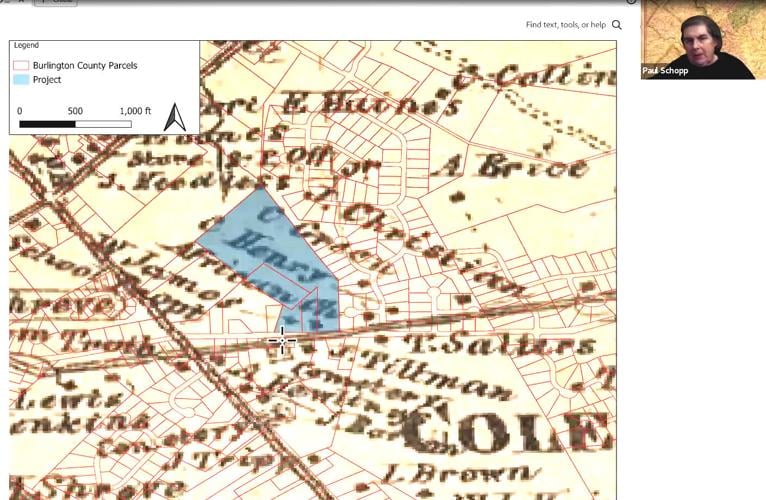

Historian Paul Schopp of Riverside, upper right, shows the site of two buildings important to Mount Laurel's Black history on an old map. The blue shading represents the development and the two buildings are small marks fronting Elbo Lane.
Historian Paul W. Schopp told the Mount Laurel Planning Board last week that he was concerned that a proposed residential development could destroy bits of Black history buried in the Colemantown section of town.
But his campaign for an archeological dig before the excavators moved in got nowhere.
Orleans Conservatory Group Partners LP, part of JP Orleans builders of Conshohocken, Pennsylvania was before the board on January 15 for preliminary approval to clear part of a 26.43-acre site on Elbo Lane and build 13 single-family houses.
Unlike residents who ordinarily testify at planning boards with traffic, landscaping or stormwater concerns, Schopp told members the building site once held historically significant structures for Mount Laurel's early Black community and that there may be long-buried artifacts.
"It will be impacting the site of William James' house, who was originally a man of color who came from Delaware, and more importantly, we'll be impacting the original site of the Colemantown Meeting House, which during the week served as a public school for African-American children," Schopp told the board.
"What I'm suggesting is that some archaeological investigation be conducted on those two sites before excavation begins," he requested.
Jacob's Chapel AME Church, another significant part of Mount Laurel's Black history that is on the National Register of Historic Places, sits about 600 feet across Elbo Lane from the building site.
But, unlike the church, the buried remnants of the meeting house and the James house are not protected by the state or federal register.
Without historic protection, an archeological dig ordered by the Planning Board "would be asking for the applicant to go out of their scope of what's required under municipal land use law," said Township Manager Meredith Riculfy, who also is a member of the board.
Added board planner Joseph Petrongolo: "That's not something that is required to do. Our ordinance doesn't require it. The state doesn't require it. So, I mean, it's not something that we can require as a condition of any type of approvals or anything to that effect for this application."
Schopp then appealed to the giant homebuilder, asking it to consider allowing a dig.
"Perhaps Orleans, being a good neighbor, would be interested in doing it even if they're not required to do it," he said.
Larry Dugan, JP Orlean senior vice president and general counsel, was at the meeting and quickly gave Schopp his company's answer: "I'm not agreeable to having a further archaeological investigation on the site."
Schopp showed the board a historical map that marked the James house and meeting house fronting Elbo Lane on the building site.
The James house "was domestically occupied and I'm sure that there are some artifactual deposits around that site as well as around the original site of the Colemantown Meeting House, which, as I said, served as a school during the week," Schopp said.
Neighbors of the planned development testified they were worried about the new houses' impact on existing trees and stormwater runoff.
Board members voted unanimously to approve the Orleans preliminary major subdivision plan. The developer will need to return for approval of its preliminary and final site plans.
Previous coverage on 70and73.com:
- Residents hire their own lawyer to question Mount Laurel residential development before Planning Board.
- Approval process for 13-house development in Mount Laurel begins with Planning Board.

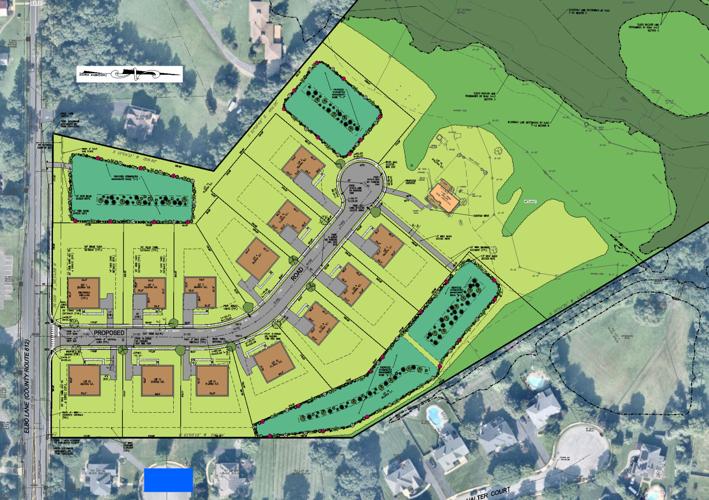
The development and its road would begin on Elbo Lane, on the left.


