

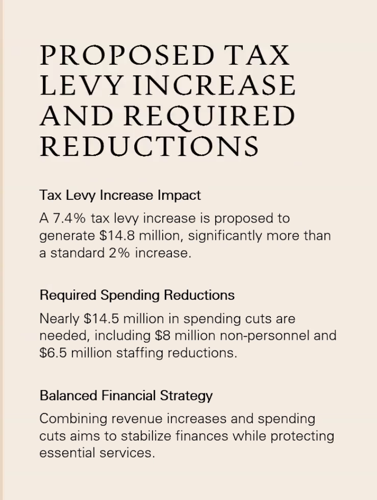

A severe Cherry Hill schools budget deficit could require raising district property taxes by 7.4% and cutting deeply into personnel and non-personnel costs, the Board of Education heard on Thursday evening.
A home with the district's average property assessment would pay $420 more a year under the proposed 2026-27 school budget. Details on the average were not disclosed in the presentation, but in 2025 the average property assessment was $226,977 and the school tax bill was $6,137, according to state statistics.
The tax increase is expected to generate $14.8 million.
"A lot of tough decisions, I know, had to be made even for this current year," Jason Schimpf, district business administrator, told the board. "And unfortunately, we're in a situation where we're going to have to continue making very difficult and consequential decisions just based on the financial reality."

Schimpf, who is new to the district and overseeing his first Cherry Hill budget, said the district faces $14.5 million in spending cuts — about $8 million in non-personnel reductions and $6.5 million in staffing cuts.
The sharply higher tax levy exceeds the state's 2% cap, but the district would use an exemption that allows it to impose higher property taxes because of "extraordinary increases" in the cost of health benefits. The balance would come from the district's "banked cap," which reflects the taxes the district did not impose in the past to reach the cap.
Costs for health and prescription insurance — both mandated by the state and not subject to contract negotiations — have skyrocketed for Cherry Hill and other districts in New Jersey, Schimpf explained.
After negotiating with the district's insurance carriers, the medical insurance increase was reduced to 19.9%, amounting to a $7 million increase. The prescription drug premium went up 27%, or a $3 million increase.
Busing costs also are increasing in the proposed 2026-27 budget by $1.3 million. Schimpf said the district already has negotiated the transportation contracts and if the district were negotiating today then higher oil prices would mean an even greater increase.
The budget cuts come as Cherry Hill also faces a decline in state aid that was announced last week.
The district's tentative budget will be presented at a meeting next Tuesday, March 24, and sent to the state Department of Education for a technical review by March 27. A public hearing and adoption of the final budget is scheduled for April 28.
"We're talking about $15 million worth of reductions to programs and services we provide and also telling our taxpayers and our parents that we're going to raise their tax bill $420. And that's just on the average assessment," Schimpf told the board.
The district over the last couple of years used "substantial amounts of fund balance or surplus" to balance the budget, he said. Much of the surplus has been spent and the "difficult structural reductions" in the district that were delayed now need to be faced.
Board members and the public railed against the state legislators who represent the district in Trenton.
"Politics should not be playing a role in this. Our kids and our community should be most important," resident Anne Einhorn said during the public comment part of the meeting.
"What are they doing?" Einhorn asked of state Assembly members Louis D. Greenwald and Melinda Kane and state Sen. James Beach.
"I hope you all finally get angry," she told board members. "You could be professional. I don't have to be professional."
Ilana Yares, of Fair Funding for Cherry Hill Public Schools, said she has given up on the district's representation in the Legislature.
"They still get elected, but they need to do their business and help Cherry Hill instead of what they're doing right now," she told the board.
Carole Roskoph, a longtime Township Council member who did not run for reelection last fall, said radical change is needed in the way New Jersey schools are funded.
"When we are going to Trenton we need to have the conversation about changing the state Constitution so that schools are no longer funded through property taxes," she said.
Resident Laurie Neary called the tax increase "staggering."
"I've been listening to the presentation and 'sick to my stomach' is probably an understatement at this stage," Neary said.
She added: "You won't have to worry about how we educate these children because people will not be able to afford to live here."


