
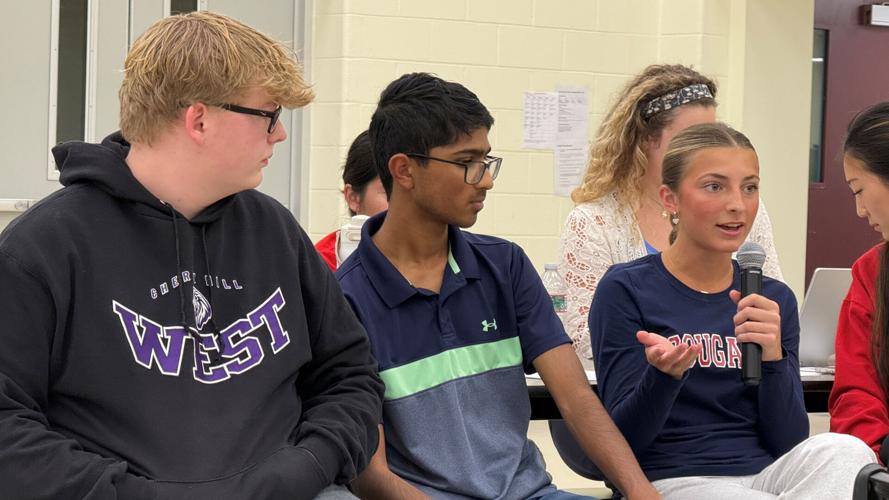



Logan Freedman, a Cherry Hill East High School senior, expresses concerns about younger students relying too much on AI. Looking on, from left, Mason McAuley, a Cherry Hill West senior, and Vasu Medavarapu, a junior at East.
Logan Freedman worries that if young students rely too much on AI, they will miss out on learning the fundamental skills of research and communications.
Reading textbooks, looking for problems and communicating when they need help are important for younger students, said Freedman, a senior at Cherry Hill High School East.
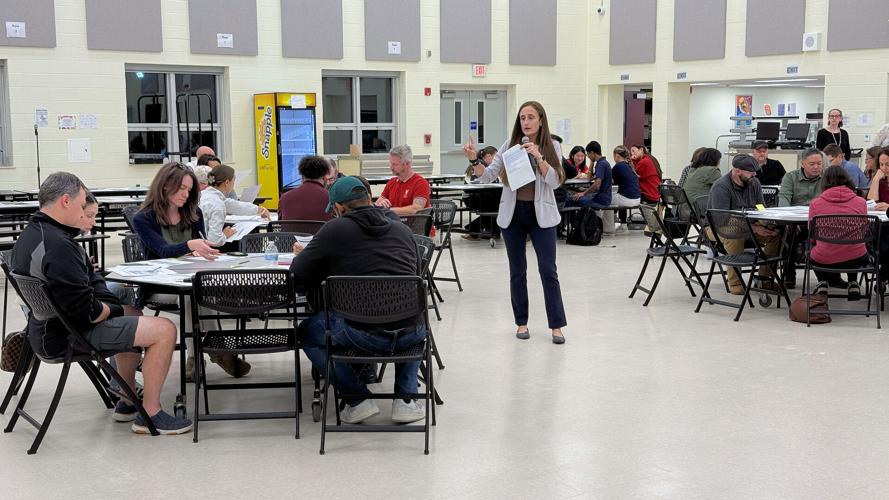
"I went to middle school and elementary school in a time when I didn't have AI, so that I was forced to communicate with my teachers, with my friends....You kind of have to go through that hardship to be able to effectively use AI and use technology so that you still have your foundational skills," Freedman told about 50 Cherry Hill residents last week at Rosa International Middle School at a board of education session meant to understand community concerns about technology in the schools.
The adults in the room cheered Freedman and the other high school students sitting at her table who shared their thoughts on screen time, the use of smartphones during school hours and the role of AI in learning.
"The students should know that this is also an adult problem, not just a student problem, and everyone's trying to navigate this," one resident said after Freedman spoke.
Board President Gina Winters said technology was selected as the first of the board's continuing community discussions because concerns about AI and the use of computers and smartphones are timely.
Like other districts, Cherry Hill — the largest in South Jersey — has worked to craft acceptable technology guidelines.
Much of the discussion on AI use focused on how much is too much and what are acceptable uses of AI in the learning process.
One parent said any policy needs to make it clear that AI answers should be taken at face value.
"Humans are lazy and most people are just going to take the answer," he said of AI users. Students need to be trained to fact-check the AI answer and click into the links to more deeply research the facts, he said.
The district's AI implementation plan offers grade-level guidelines for using the technology. In high school, the "full range" of AI use is available based on each staff member's directions in assignments.
"AI use should augment, not substitute for, student intellectual engagement," the plan notes.
AI platforms used in teaching must be on the district's approved list. Prohibited uses of AI include submitting AI-generated work as a student's and failing to disclose the use of AI when disclosure is required.
Parents at the meeting last week also offered their opinions on restricting their children's screen time.
One mother said the use of technology has negatively impacted her son's ability to complete his homework.
"My eighth grader doesn't have strong handwriting, can't read or write cursive and also can't type," she said. "So he's very unproductive when he's asked to do homework, and a lot of times he asks me to be his stenographer."
Other parents shared their issues with YouTube videos shown in class as opposed to live instruction.
The district's screen-time guidelines recommend, for example, only up to two hours of recreational screen time daily for sixth through eighth graders. Educational screen time for the same grades should be limited to no more than one hour per class during the week and no more than one hour each day at home for homework.
One table of parents had an animated discussion when they discussed the district's prohibition of internet-enabled devices, such as smartphones, on school grounds during the school day.
"People are playing Uno in the cafeteria and I'm like, oh, my God. It's like the 90s, 1993 all over again," one parent said.
A mother said her elementary school daughter fell off her bike on the way to school and scraped her knee.
"I didn't hear about it till 9 p.m. They figured it out when she got to school, she went to the nurse," she said. Rather than calling mom, if she had a phone, the child "had some resiliency and figured it out," the mother said.

Renee Cherfane, a Cherry Hill board of education member, was one of the discussion leaders with members of the community.


