
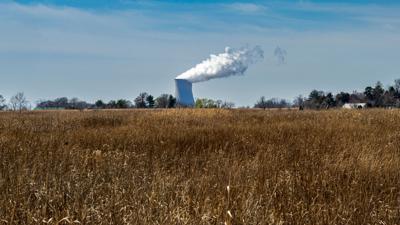


Water vapor rises from a cooling tower at a Salem, New Jersey nuclear power generating station in March. It is one of three operating in New Jersey.
Facing sharply rising electricity costs and projected demand increases in New Jersey, the Board of Public Utilities this week publicly launched plans for a deep dive into the possibility of expanding nuclear power generation in the state.
"New Jersey, and the region, need more electricity, and since day one of the Murphy Administration, our commitment to supporting our existing nuclear fleet has never waned," Christine Guhl-Sadovy, president of the New Jersey Board of Public Utilities, said in a statement. The state agency oversees regulated utilities, such as electric companies.
New Jersey's three nuclear reactors — Salem 1, Salem 2 and Hope Creek in Salem County — generate 40% of the state's electricity. The Oyster Creek nuclear generating plant in Ocean County was shut down in 2018 when it was the nation's oldest operating power reactor, according to the U.S. Energy Information Administration (EIA).
The state's last two coal-fired electricity generating power plants went dark in 2022, which with the Oyster Creek shutdown has resulted in New Jersey becoming a net importer of electricity, according to the EIA. "New Jersey consumes more electricity than it produces and in 2023 it obtained nearly one-fifth of its power from generators in other states by way of the regional grid," the EIA reported.
Officials have blamed the fact that New Jersey now must compete with other states to purchase electricity as one reason for the rising rates consumers are seeing. Consumer electric bills in the state are expected in June to rise by at least $25 a month, a boost that sparked hearings before the state Senate and Assembly in March.
"New Jersey and the larger PJM Interconnection L.L.C. region (the electric supply grid) face increases in electricity demand as a result of load growth from AI data centers, new manufacturing facilities and other energy intensive industries," according to the BPU report. "Nuclear technologies...are potential opportunities that can help meet the growing need for new sources of generation."
Electricity demand in the region is expected to grow by nearly 40% in the next 14 years, according to the BPU report.
The BPU on Monday issued a formal Request for Information, seeking questions answered by "interested parties" and members of the public. Responses are due June 23.
Questions explore the role of nuclear in the state's energy production, the different types of nuclear plants and where they should be located, nuclear safety and nuclear waste and what part the state government should play.


