





Property taxes in New Jersey, which by far has the nation's highest effective property tax rate, top the list of major pain points for most homeowners in the state.
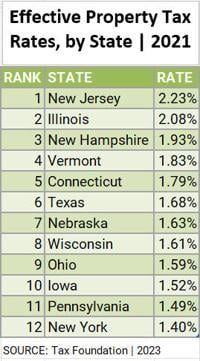
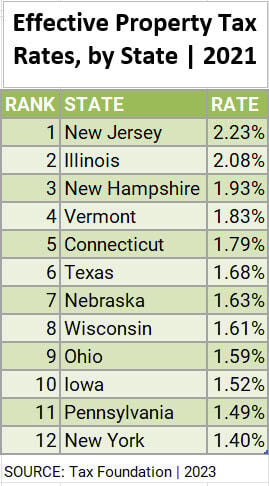
New Jersey's effective property tax level was far beyond other states in 2021, the most-recent year available, according to the nonprofit Tax Foundation. States like Massachusetts, New York and Pennsylvania did not even make the top 10 list that New Jersey led with a 2.23% effective rate, followed by No. 2 Illinois with 2.08%, according to the research by the Tax Foundation, which bills itself as the world's leading nonpartisan tax policy nonprofit. The median effective rate for all states was 0.9%.
"One of the highest barriers to affordability in New Jersey is property taxes," Gov. Phil Murphy said in his state budget speech a year ago. "We hear it from the people we meet. We know it ourselves," Murphy said.
"For far too long, leaders from both parties have stood at this podium talking around property taxes without actually doing anything real about them. We stopped just talking about them and did something," said Murphy, who has pushed for property tax relief through the ANCHOR and the Stay NJ tax credit program.
Murphy likely will bring up property taxes, and relief, in his fiscal-year 2025 budget address scheduled for Tuesday afternoon in Trenton.
In the 70and73.com area, the largest total tax levy — the total amount collected for property taxes — is in Cherry Hill, which is the most-populous municipality in South Jersey, according to data from the New Jersey Division of Taxation.
Cherry Hill property taxpayers — from homeowners to commercial property owners — faced a total levy in 2023 of more than $313 million. In other larger communities: Mount Laurel, about $164 million; Evesham, nearly $160 million and Voorhees, $136 million, according to county abstracts of ratables filed with the state.
Where does the money go? Overwhelmingly, to educate local students.
About 72% of Medford's tax levy goes to support its township K-8 school district and the regional Lenape Regional High School district. For Mount Laurel, 69% goes to schools; for Evesham and Moorestown, 67%; for Medford Lakes, 66%; for Cherry Hill, 62% and for Voorhees, 53%. All of this represents property tax dollars and does not include state aid or other sources of income.
In Cherry Hill, coming in second place was money allocated to Camden County government (22% of the total) and then to the municipal budget (14%).

Voorhees contributed 20% of its total to Camden County government.
However, Burlington County communities contributed far less of a share of their total property tax bills to their county government. Mount Laurel taxpayers contributed 14% of the total taxes collected to the county budget and Evesham contributed 12%.
One of the greatest influences of how much a homeowner pays in property taxes is the value of the property itself. So, it is not surprising that the highest average municipal property taxes in the state are in the priciest communities, particularly those in North Jersey and in the Jersey Shore communities. The state data listed average property tax bills for 585 municipalities.
Haddonfield, in Camden County, ranked 37th in the state for its total average residential property tax bill in 2023, according to a 70and73.com analysis of state data. The average bill in Haddonfield was $16,672, which was up 25% from 10 years before, in 2013.
The Haddonfield 10-year increase did not keep pace with consumer inflation, which, measured by the Bureau of Labor Statistic's Consumer Price Index, increased about 31% nationally in the same period of time.
Other average tax bill standouts included Moorestown, ranked 113th-highest in the state with an average $12,211 bill, up 19% from 10 years before; Voorhees, ranked 159, with a bill of $11,084, up 27% in 10 years and Medford, ranked 172, with a bill of $10,904, up 16%.
Cherry Hill had the 315th-highest average bill in the state with an average tax bill of $8,851, up 15% from 2013.


