
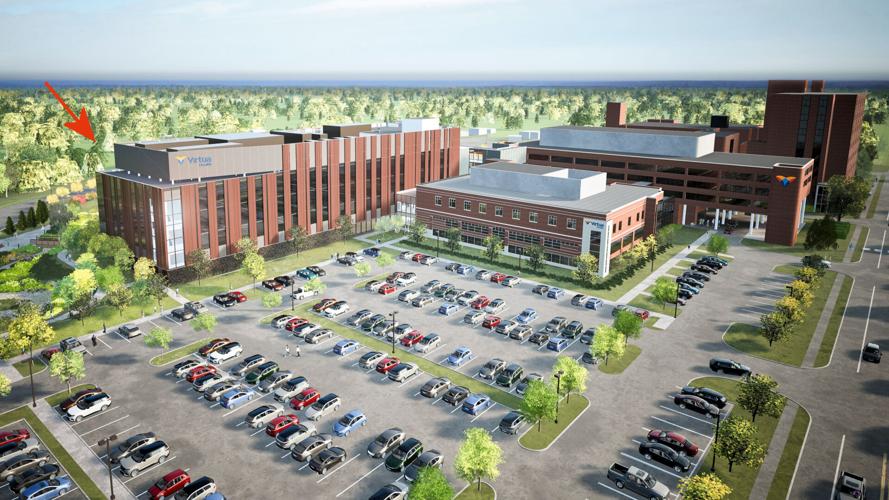

The new hospital tower at Virtua Mount Holly Hospital in this rendering is at the top left.
When Virtua Health took over Our Lady of Lourdes Hospital in Camden six years ago, one "true gem" that was not immediately obvious is today shaping the future of Virtua's workforce.
Virtua has been able to build an expansive training program around the Lourdes nursing school and has produced hundreds of new nurses each year in an industry suffering from a shortage.
"It was a true gem. It was like a diamond that we didn't even know and maybe even Lourdes didn't know," said Dr. John Matsinger, Virtua executive vice president and chief operating officer.
The Lourdes Nursing School has been moved to the Rowan University Stratford campus and students are "all doing rotations with us during their training, and we've been able to offer many of those nurses opportunities to join Virtua upon graduation, and they have," Matsinger said during a wide-ranging interview about Virtua and its philosophy, strategy and technological advances.
Virtua is aggressively expanding its existing properties, exploring joining with Wilmington-based ChristianaCare into a new regional health system and testing new ways to provide health care. That includes this summer’s opening of the Oliver Station senior citizen apartment building in Camden that sits atop a 5,200-square-foot Virtua primary care office with 10 examination rooms staffed by Virtua physicians.
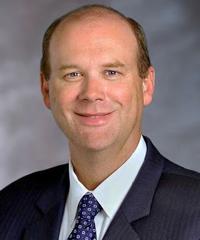
Dr. John Matsinger, Virtua executive vice president and chief operating officer.
"Our mission is that Virtua helps you be well, get well, stay well. That's what we do every day. That's our North Star," Matsinger said.
In May, Virtua celebrated both the 75th anniversary of the Lourdes hospital and a $500 million addition of a six-story patient tower at the Haddon Avenue hospital. The tower will be named the Marvin Samson Pavilion for the longtime Virtua board member who pledged $5 million to Virtua.
But Matsinger pointed out that the new pavilion represents only a small part of the changes that have been ongoing at the hospital, founded in 1950 by the Catholic Franciscan Sisters of Allegany, New York.
"We're redoing the entire Lourdes campus," Matsinger said. "The expansion is a new bed tower, but every part of that campus is being redone as we speak."
Matsinger noted: "We realized that we needed to transform the organization, especially with Lourdes joining the organization, to really move into being a tertiary academic medical center at Lourdes, but also an academic health care system at Virtua."
The space formerly occupied by the nursing school was replaced in July by the Neuroscience Intensive Care Unit (Neuro ICU), with 18 patient beds focusing on patients who have suffered strokes or who have brain tumors or seizure disorders.
"If you have a stroke, you could end up in that unit. If you have brain surgery, you could end up in that unit. If you have advanced spine surgery, you could actually end up in that unit because that's all part of the neurovascular team," he explained.
In the last six years, Virtua has invested a couple of hundred million dollars in the Lourdes infrastructure, including its information technology for electronic medical records and the HVAC system, among other large-scale projects.
As in Camden, Virtua is adding to its hospital in Mount Holly, Burlington County. The new four-story, 137,000-square-foot tower will house 64 private beds and 10 operating rooms.
While it may seem that the Samson donation would go to help pay for the pavilion named after him, that will not be happening.
Samson's "dollars will not go to build any of that building. Not one cent will go into that building," Matsinger said. Instead, one of Samson’s passions is education and Virtua is now figuring out what type of education his contribution will support.
"We philosophically don't think that our philanthropic dollars should go to brick and mortar. We will figure out how to do that through operational imperatives," Matsinger said, adding that the expansions typically are financed through operating funds rather than debt.
Donations to Virtua Health instead "belong in the community" and they are directed to local charitable initiatives such as Virtua's mobile grocery store and mobile farmers market that stop weekly in several South Jersey communities.
Virtua has had a long-standing presence in Camden, dating back to the late 1800s. Besides Lourdes and Oliver Station, it has a variety of care and rehab offices on Atlantic Avenue.
"Camden is a walking community, it's a public transportation-dependent community," Matsinger said. "That's why we run so many mobile programs in the city of Camden for those who can't get there."
Virtua's mobile philosophy applies to other services in South Jersey, including a mobile pediatric unit and mobile cancer screening.
The health system is closely watching its Oliver Station initiative in partnership with Camden-based developer The Michaels Organization. Hospital executives have discussed the possibility of more projects combining primary care and apartments like Oliver Station, which is being viewed as transformative, Matsinger said.
"What we would like to see is the success of Oliver Station and then think about where the next could be," he added.
On "any given day, I'm taking care of more people in their homes than I am in our acute care brick-and-mortar hospitals," Matsinger said.
About 1,400 patients are getting Virtua attention in their homes each day, compared with about 1,200 at the Virtua hospitals. Before the COVID pandemic, the number being treated in the home totaled about 800.
Many patients do not favor hospital stays.
"I think that people want to be at home when they can be. They want to get their care there. Sometimes it's not the appropriate venue. We're learning more and more," he said.
Nearly all the hospital system's soft tissue surgery — from appendectomies to hernia repairs to gall bladder surgeries — no longer require the surgeon's hands inside the patient's body.
Robotics, controlled by the surgeon, are making far smaller incisions and, while in the patient, can move 360 degrees and in other ways that the surgeon's hands could never emulate, Matsinger explained.
The outcome is faster recovery, minimal pain, less time spent under anesthesia and far less time spent in the hospital — if at all.
"Surgeries that used to keep people in the hospital for days, they're leaving in hours," he said. "People are going home faster, they're going home on less pain medications, and they're getting back to their normal life significantly faster."
And then there is Artificial Intelligence, the AI that has captured the attention of the public and businesses.
"We're all going to have to figure out AI," Matsinger said.
To Matsinger, the application of AI is simple: harnessing data and gaining insight to improve patient care.
An example is how Virtua is using AI to assist physicians in real time as they conduct colonoscopy exams.
The system used by Virtua has pulled together videos from millions of other colonoscopy exams and offers advice to the physician during the exam.
"Hey, just look up in that corner. That doesn't look right," the AI technology might recommend based on its learning from the millions of exams.
Sometimes it's nothing. At other times, the physician realizes "that could be something. Let me take a little deeper look at that," Matsinger said.
"Any GI doctor (gastroenterologist) can go in and see a big cancer. That's not challenging. It's making sure you don't miss the small adenoma that, in seven years, is going to be a big adenoma and turn into a colon cancer. So we have a phenomenal adenoma detection rate," he explained.
The "true gem" of the Lourdes nursing school has guided Virtua to expand its nursing education programs with multiple entry points for student nurses, from the traditional RN program to a four-year bachelor's degree program started four years ago with Rowan University.
Virtua also assists employees in entry-level positions who aspire to nursing by working with them to get to college and offering financial assistance for their education.
"Our path in the future is to help build the clinical staff of the future to help fortify Virtua," Matsinger said.
Besides investing in nursing education, Virtua has also expanded the residencies it offers newly minted doctors out of medical school.
The Virtua system has gone from having about 20 residents to now, after seven years, having 300 residents.
Matsinger said Virtua realizes that not everyone who graduates from its nursing or physician training programs will become a Virtua professional.
But there are clear advantages for both the graduate and Virtua in staying, he said. They know the culture of Virtua and Virtua knows them.
"To (hire) 50% of the residents graduating is phenomenal," he said. "In some programs, we've gotten 80% to 100%."


