

With President Donald Trump wanting the economy to reopen soon, governors from six states including New Jersey announced Monday they have formed a collaboration to cooperatively lift restrictions and reactivate their economies when the time is right.
"This is about being smart. Not political. Smart," New York Gov. Andrew Cuomo said at a press conference attended over the phone by the governors of New Jersey, Pennsylvania, Delaware, Connecticut and Rhode Island.
Cuomo said he believes New York State has reached a plateau in the number of COVID-19 cases. "That is relatively good news in a world of bad options," Cuomo said.
NJ COVID-19 HOSPITALIZATIONS
| CATEGORY | PATIENTS |
|---|---|
| Hospitalized | 7,781 |
| In Critical Care beds | 1,886 |
| On ventilators | 1,611 |
| Discharged (previous 24 hours) | 556 |
| as of 10:30 p.m. April 12, 2020 |
In New Jersey, "we have not yet plateaued," said Gov. Phil Murphy. The number of infected seems to be flattening, but "an economic recovery only occurs at the back of a healthcare recovery," Murphy said, adding that "this is the fight of our lives."
At his daily briefing later in the day, Murphy said: "We have to try to avoid a second surge (of infections) at all costs." Even if we do everything perfectly reopening the state, these sorts of viruses on their own have a second or third potential life associated with them, he said.
Governors of the six states said their economies are intertwined and they need a coordinated approach.
Cuomo said the states were left to make their own decisions on shutting down and will make decisions on opening up again. The president has the power to take over that decision, Cuomo said, but the "governors need clarity."
"You're not going to have a health economy if you have an unhealthy population," Pennsylvania Gov. Tom Wolf said at the collaborative's press conference.
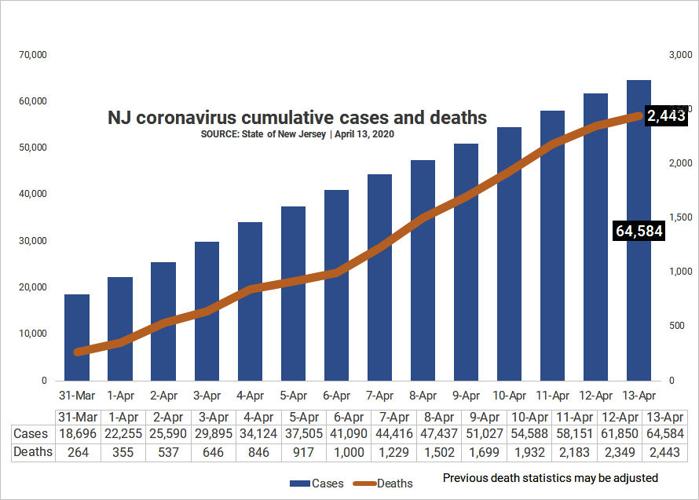
Meanwhile, Murphy on Monday reported 94 new COVID-19-related deaths, taking the state total to 2,443. The number of confirmed cases in the state reached 64,584.
Camden County on Monday evening reported 10 new COVID-19-related deaths: six in Cherry Hill, three in Voorhees and one in Camden. The county now has had 39 deaths. The latest were:
- Camden man in his 80s
- Cherry Hill woman in her 90s
- Cherry Hill woman in her 90s
- Cherry Hill man in his 90s
- Cherry Hill man in his 70s
- Cherry Hill man in his 90s
- Cherry Hill woman in her 80s
- Voorhees woman in her 90s
- Voorhees woman in her 80s
- Voorhees woman in her 80s
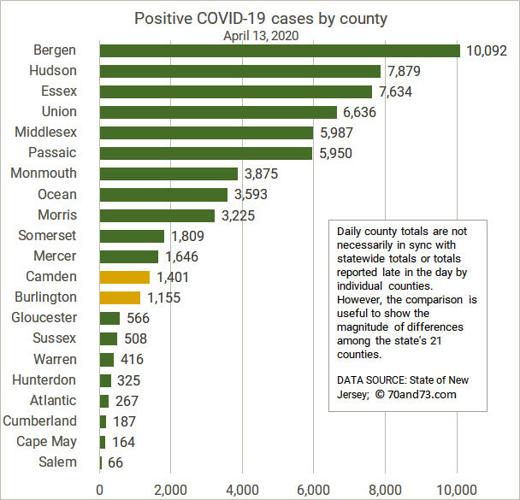
Camden County also Monday reported 127 new cases, taking its total to 1,383. Communities reporting the greatest number were: Camden (40), Gloucester Township (15), Pennsauken (13), Lindenwold (12), Cherry Hill and Winslow (8 each) and Voorhees and Collingswood (4 each).
The older deaths in Camden County follow a continuing pattern in the state. Nearly eight out of 10 deaths in New Jersey from COVID-19 have been residents 65 and older, the state reported Monday.
Burlington County late Monday reported 47 new cases, taking its total to 1,153. Communities reporting the greatest number were: Willingboro and Moorestown (9 each), Pemberton Township (7), Burlington Township (5) and Delran (3).
With 202 total cases, Willingboro, by far, has the largest number in Burlington County. While Willingboro accounts for about 7% of the total county population, it has nearly 18% of the total of COVID-19 cases. Burlington Township has 107, Evesham has 88 and Mount Laurel has 79. The county has had 24 deaths and no new ones were reported on Monday.
The requirement to wear a face covering in retailers is being enforced. In Toms River over the weekend, a man refused to wear a covering in a Wawa and became belligerent, said Col. Patrick J. Callahan of the New Jersey State Police. The maskless man was arrested. He was released and went to another Wawa without a covering and got into an altercation with another customer. The man was arrested again and held in the Ocean County jail.
Murphy also said he has signed an executive order prohibiting cable and telecommunications companies from terminating internet or voice service because of nonpayment until 30 days after the emergency has ended. Any service disconnected after March 16 because of nonpayment must be reconnected, according to the order.
"This is no time for anyone to have their connection to the world severed," Murphy said.


