

Updated with the news that the home's demolition now is not planned.
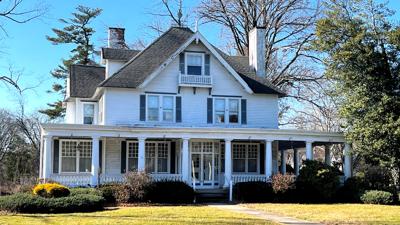
For 134 years, the huge white house has occupied a corner lot on Moorestown's Chester Avenue, a short walk from the town's historic Main Street. Built for Philadelphia merchant John H. Perkins, the structure's 4,887 square feet held seven bedrooms.
In recent years, it was refitted as a funeral home operated by Burlington County funeral business Lankenau.
Lankenau pulled out of Moorestown a year ago and sold the property to land investors, whose lawyer appeared before the Township's Appearance Committee last May with plans to tear it down.
The property's owner could have applied for a demolition permit in late September, but has yet to do so, according to the Township. The lawyer told the committee at last May's meeting that the owner did not know the home's historical significance at the time of the purchase.
Now the house, built in 1889, will be spared.
"There is no intention to tear it down," lawyer George Matteo of Connell Foley in Cherry Hill told 70and73.com late Thursday afternoon. Matteo represents owner Pennsylvania-based Levins Group, which has applied to the Planning Board to split the lot in two — keeping the building and constructing a new home on the other lot.
Worries and handwringing among some in town over the thought of losing the building have made the John H. Perkins House a poster child, of sorts, for a new push for a historic preservation strategy by Township government. That plan got its start this week at the Township Council meeting.
"I very strongly believe that we need historic preservation in this town in a regulatory way," Council Member Sue Mammarella said at the Monday night meeting.
Council members discussed applying for a state grant to allow the Township to hire a planner, who would develop a proposed historical preservation law, which would include creating a historic preservation commission.
"I hope that this will be the first step toward this greater good I think for Moorestown to help protect structures from not only being torn down or altered in a very unpleasing way, but if there is anything to be built in what will be our historic center...that also may be subject to looking the way we need it to look in Moorestown," Mammarella said.
Mayor Nicole Gillespie, calling it a "complex issue," said the Township should go after the grant, but also keep in mind the balance between preserving history and the rights of property owners.
About 20 years ago, the Township unsuccessfully tried to regulate historic preservation and it turned out to be highly contentious debate.
"We don't want a repeat of that," Gillespie said. "We don't want people to feel that this is being forced down their throats."
Overstepping by Township government is a concern, Council Member David Zipin told fellow Council members.
"You're dealing with something different because when you're talking about laws that are restrictive, the theory is for the greater good. And obviously the greater good of something like historic preservation is somewhat subjective," he said.
But Dorothy Guzzo, executive director of the state's New Jersey Historic Trust, which was created by law in 1967 to preserve historic resources, said preservation should not be viewed as subjective. It is part of zoning, she told Council, and the way to avoid debate is to have a professional at historic commission meetings to provide guidance to its members.
Moorestown would apply to the Historic Trust for a grant to get the process of preservation started.
A preservation ordinance would prescribe a process for someone with an application, including design guidelines to maintain the "architectural brilliance" of Moorestown, she said.
If someone proposes to rehab a historic property, she said, the ordinance also would give suggestions for "the appropriate way to do that where you're preserving the character but still allowing people to live in their houses."
Lenny Wagner, president of the Historical Society of Moorestown, said that if historic preservation laws can work for communities like Haddonfield and Collingswood, they can work in Moorestown.
"We see it as really critical to preserving the historic nature of the town," he said.
David Schill, president of the Moorestown Improvement Association, a civic group, agreed. "We need to save what's left of our historic town," he told Council.
The concern over the future of the Perkins House illustrates the absence of regulatory power over historic preservation in the Township.
The Township Appearance Committee, whose mission is "protecting and enriching the character of Moorestown," advises and makes recommendations, but can do little more.
It can delay the demolition of a building for up to 180 days as the owners are lobbied to sell or find another use for the structure, so the building will not disappear.
That's what the committee did last year, postponing the issuance of a demolition permit for the Perkins House at 334 Chester Avenue until last September.
Lawyer Matteo now says the owner wants to build a home on what would be an open lot on the 1.4-acre property at Chester and East Central Avenues. First, the Township Planning Board next Thursday must give permission for the lot to be divided into two.
As for the future of the historic home, there are no plans for it at this point, he said, adding that the next step is to "find an appropriate use for it."
"I can only hope they do sell to someone and keep the home intact," Appearance Committee member Patricia Canton told 70and73.com this week in an interview.
"It would be tragic for the town if we lost it."


