
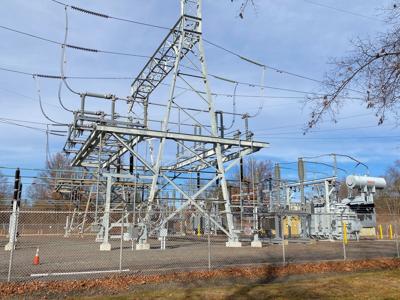


PSE&G's Marlton substation.
Canvassers paid by nonprofit Food & Water Watch earlier this year gathered more than 1,700 petition signatures from Cherry Hill residents who back a local-ordinance proposal that would require a Township-government electricity pool, which eventually would be supplied only by renewable energy sources, such as wind or solar power.
The petition drive had enough support to get the proposed energy aggregation ordinance on Tuesday night's agenda of the Cherry Hill Township Council, which cannot change or edit the law as proposed in the petition drive.
If Council members take no action on the ordinance, state law requires it to go to all Cherry Hill voters at November's general election.
Under the proposed ordinance, 60% of the electricity provided through the pool to the town must come from renewable sources beginning in 2022. The percentage increases over time and, by January 2030, all energy sold would need to come from the renewable resources.
Residents would be able to opt out of the pool and use another electricity provider. Non-residential customers could choose to opt into the program.
But the program has had mixed results elsewhere in New Jersey and one of its most vocal detractors has been Brian C. Wahler, the longtime mayor of suburban Piscataway in Middlesex County.
"The devil is in the details," Wahler told 70and73.com in a telephone interview last week.
Piscataway faced a similar petition drive and voters overwhelmingly backed the clean energy aggregation pool for residences in that town.
However, more and more residents later opted out — nearly two-thirds left the pool — and electricity suppliers did not bid to provide energy for the pool, which started in October 2019 and ended this fall, Wahler said. The cost of energy in the Piscataway pool went up sharply compared with other providers, he said.
"It totally failed," Wahler said. "It failed so miserably that the BPU (state Board of Public Utilities) had to step in and actually had to halt the program."
Jocelyn Sawyer, Food and Water Watch's South Jersey organizer, alleged that Wahler worked to sabotage the program in Piscataway. She said the Washington, D.C.-based nonprofit is working with six communities in the state this year to set up community energy aggregation pools. Collingswood is in the process of switching on its program, she said.
"I feel like our Township has good capabilities of people in government who would be competent at implementing the project," one of the local organizers, David Stahl of the Kingston neighborhood, told 70and73.com.
The East Tampa Avenue resident was a member of the organizing committee with Kristen Affrime of Graham Avenue, Susan Druckenbrod of Valley Run Drive, Tiffany Hare of Ramble Road and Susan McGunnigle of Rose Lane, according to the Township.
Druckenbrod said that the petition got a generally good response from town residents, many of whom are aware of the environment but "also feel powerless" in addressing the climate crisis.
Township Council President David Fleisher, who spoke about the petition and ordinance at the November 22 Council meeting, called the aggregation program "fairly complicated."
"I know that members of council are in the learning process," Fleisher said. "I know they've asked for a lot of information. They're in the process of reviewing what that means, how it may impact residents. This is the very start of it."
In past decades, electric utilities such as Public Service Electric & Gas generated the electricity and transmitted it into homes. PSE&G continues to transmit the energy, but users can select competing electricity producers. PSE&G continues to remedy power emergencies or deal with a homeowner's line problem.
Under the proposed energy aggregation ordinance, Cherry Hill Township would oversee the pool of electricity offered over PSE&G lines to its residents. Companies providing electricity from renewable sources would bid on the contract to be the supplier for Cherry Hill residents, who could opt out of the program and seek their own supplier. Non-residential customers could opt into the energy pool.
Community energy aggregation programs are not new. Some communities have banded together to find less-expensive suppliers for their residents. The Food & Water Watch model, however, adds the requirement of using renewable energy in the mix.
Mayor Wahler of Piscataway said he believes community aggregation programs could, in theory, result in lower electricity costs for pool members. But putting benchmarks for renewable energy in the ordinance can increase the cost of electricity, he said.
"What may have looked good on paper...turned out to be something very terrible financially," Wahler said of the program in his community.
The Council in Piscataway chose to let voters decide on the aggregation plan — about seven out of 10 voted in favor — but after the program did not work out the township had to field hundreds of phone calls from angry homeowners.
"They thought it was the town (government) that did it," Wahler said.


