


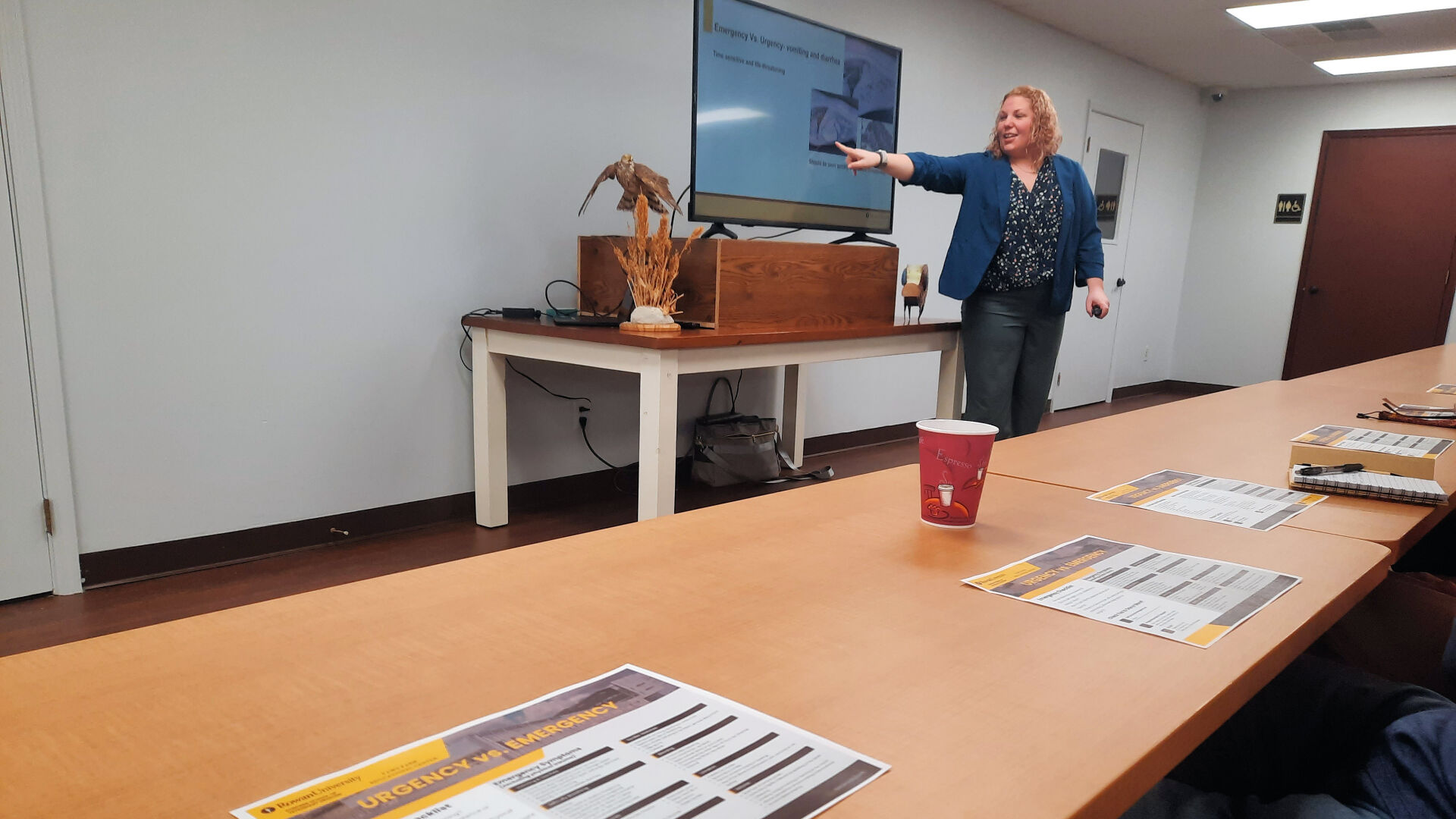
Lindsey Jett of the Shreiber School of Veterinary Medicine of Rowan University leads a seminar Thursday at PAWS.
The PAWS Farm petting zoo and wildlife education complex in Mount Laurel, which opened in 1979 and shut down in 2020, welcomed the public on Thursday as part of the mission of its new operator.
The Shreiber School of Veterinary Medicine of Rowan University, which now oversees the Township-owned property, held its first free program at the Hainesport-Mount Laurel Road facility as part of a series to inform pet owners.
"Urgency vs. Emergency: When to Worry and When to Hurry" explained how to judge when a pet needs immediate medical attention and when it does not.
Kate Hutton Tweedy, who with her husband Dr. Charles Tweedy founded PAWS 46 years ago, told www.70and73.com that she and her husband are pleased with what they saw and heard from the school's staff on a recent visit.
"They have great plans," Tweedy said. "PAWS will be fully engaged with the community and we are delighted. Rowan (University) is an amazing educational and academic leader and the Shreiber School of Veterinary Medicine will be an outstanding addition."
The last 18 months since the Shreiber School took over have been busy ones at the center, Phillip Barnes, the school's director of public relations and communications, told 70and73.com. He said the center was in excellent shape upon the lease's signing.
"Mount Laurel Public Works did an amazing job helping get the property ready for its next chapter by removing some trees and brush as well as older playground equipment while the veterinary school team refurbished the Welcome Center into an educational space for students and the community," Barnes said in an interview. The Mount Laurel Garden Club "continues to stay active in maintaining the butterfly garden and a new group of volunteers stepped up to help with projects like decorating and planting."
The Thursday seminar was the the first of four pet owner information sessions that organizers called the Animal Care Workshop Series.
Lindsey Jett, an emergency care veterinarian and section head of the emergency care and critical care department at the Shreiber School, explained to about 20 pet owners what constitutes a medical emergency for a pet.
A pet that "vomits excessively, is being lethargic and not able to keep anything down should come in through the (emergency room). But if your dog ate grass, vomited once and is still acting and eating pretty normal it does not need to come through the ER" but perhaps an urgent care facility, Jett said.
Another example Jett provided was that a dog that pants to cool off likely does not need emergency care. However, if a dog is panting and cannot lie down and go to sleep should be taken to emergency care.
An urgent care facility is one that treats non-emergency illnesses and performs outpatient surgical procedures during the approximately 14 hours a day that it is open, according to Jett, while emergency care facilities are those with hospitalization capabilities and treat life-or-death emergencies by triaging animals during the 24 hours that the facility is open.
"Know what is normal for your pet. Know what your pet's vitals are so you can advocate for them if something is wrong with them," Jett said. "Keep their medical records handy. Have a copy of them in your car. Have a copy of them on your phone."
Other Animal Care Workshop Series sessions will discuss cat and dog toxins, processes families with small children can utilize when contemplating adopting an animal and understanding euthanasia. Information on how to register for these sessions can be found on this webpage of the Schreiber School of Veterinary Medicine.
The wheels to create the new center were set into motion in March 2023, when the Mount Laurel Township Council adopted an ordinance that would allow the township to lease what was then known as PAWS Farm to Rowan University.
In the 1970s when the Tweedys began their involvement with the former Darnell Homestead on the property they literally rolled up their sleeves and were joined by a battalion of volunteers to rehabilitate the old farm and turn it into a popular nature center.
During the 25 years that followed, the Tweedys oversaw and helped pay for efforts that increased the site's nature and animal education opportunities, provided medical care to hundreds of animals and ensured that the site's farmhouse, blacksmith work area, smokehouse and icehouse resembled similar structures from previous centuries.
When the PAWS Farm lease on the site expired in 2004, its operations were turned over to the former Garden State Discovery Museum of Cherry Hill and the Tweedys retired.
In 2020, the Tweedys once again got involved when they learned they learned PAWS was closing and had fallen into disrepair. A total of 147,000 people signed an online petition seeking to reopen the site, the Tweedys oversaw and helped pay for a second restoration effort, which culminated in the agreement with Rowan University.
"Our goal is to honor the past and honor the legacy of PAWS Farm, while bringing Shreiber School of Veterinary Medicine to this location," said Leah Walker, the school’s associate director of outreach and public engagement.
Starting this fall, much of the PAWS Farm Educational Center programming will be geared toward "pre-K through 12th grade STEM education with the goal of sharing career pathways in veterinary medicine, science and the health professions with students," Barnes said. Programs will be led by school faculty or staff.
Animals will be housed at PAWS, but the Darnell House will be used to explain to visitors the history of the home, family and region and the Welcome Center, which will be used as a community event space.
Changes aside, Barnes said the site "should still feel very familiar to returning visitors. …The facility will continue to be a place for children in the community to have a great experience connecting with nature and animals while learning important things about the world around them.”
Barnes continued: "What is different now is that there is an intentional focus on teaching children about how we care for animals and showing them that a future career in veterinary medicine is possible for anyone, especially if they discover a passion for it."