
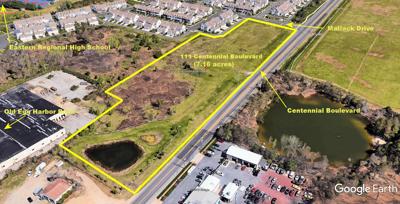

The 7.16-acre site for the ashram is at 111 Centennial Boulevard, near Eastern Regional High School.
What could be controversial about a plan to create a tranquil place for scholarly thinkers to come together to promote world peace and to brainstorm solutions for racial and religious harmony?
Well, it’s complicated and here’s why.
Last spring, after months of official hearings, lengthy discussions, detailed presentations, passionate speeches and emotional clashes, the Voorhees Township Zoning Board voted 5-2 to approve a use variance that would pave the way for a wealthy entrepreneur to build a $7 million "ashram" — described as a think tank to promote world peace — on a seven-acre undeveloped tract on Centennial Boulevard.
The plan, submitted by Paritosh Chakrabarti and his Chakrabarti Foundation, describes a place where philosophers, scientists and other degreed scholars — all ages 55 years or older — would apply for free, five-year residencies at the ashram, which would consist of 20 dwellings, a welcome center and a library open to the public.
During the hearings, Chakrabarti, a Moorestown resident and owner of global chemical company PMC Group Inc. headquartered there, testified his longtime dream has been to create a place where intellectuals could convene in an effort to solve global problems. He described his planned ashram not as a religious institution, but rather as a place for “scholarly work on a task that has a spiritual component.”
But residents from the Centennial Mill development, whose property abuts the tract where the ashram is planned, are appealing the zoners’ decision and hope to prevent it from ever coming to fruition. They came out last spring to express concern that such a place would not only disrupt their current lifestyle with traffic woes and the like, but could incite the kind of hate-mongering and extremist violence that has affected synagogues, mosques and churches everywhere in recent years.
According to township meeting records, several residents from the gated Centennial Mill 55-and-over neighborhood last spring praised Chakrabarti’s “admirable” idea, but said the site was “unsuitable” for his ashram concept. One of the residents, Francis Lettieri, concluded that a shopping center would be more beneficial to those living nearby, whereas an ashram could “wreak havoc on their well-established, well-maintained” retirement community. He added there would be “disruptions, inconveniences and disturbances” to the residents of his neighborhood if the ashram plan were to happen.
Another resident, Allan Pepper, talked about the proliferation of ethnic hate crimes in the country, and said there are concerns that the “think tank” community could become a target of such attacks. The proximity of an ashram adjacent to a “peaceful residential community,” he said, will increase security and safety concerns of the residents.
During a hearing on the use variance application last spring, Ray Gunther spoke and identified himself as president of the Centennial Mill Homeowner’s Association. He added that the residents’ opposition to the ashram had nothing to do with bias.
“There is no prejudice in the room by anybody,” he testified, explaining that there are some residents of Asian Indian descent who reside in the Centennial Mills development.
Chakrabarti, who is seeking permission to build the ashram, emigrated to the United States from India decades ago. The concept of an ashram, which is a Sanskrit word, originated long ago in India. The ashram's sponsor is himself a scholar: "Paritosh entered college at the age of 13 and at the age of 24 was the youngest D.Sc. (Chemistry) in the history of Calcutta University," according to one of his companies' websites.
Some neighbors even accused Chakrabarti of promoting disharmony rather than peace, because of the angst that is being experienced by members of the Centennial Mills community.
Voorhees resident Prahlad Patel voiced his support for Chakrabarti’s project. He said the ashram is about promoting community and living harmoniously.
“This will be at the first stop in removing interracial tension and promoting peace. The proposed ashram will bring a benefit to Voorhees, neighboring towns and the community,” he said at the time.
Another resident, Rena Patel, said that having such a cultural retreat in the township would be something positive for residents, most especially for young people. “We send our children abroad to learn cultures of the world and to widen their horizons,” she said. “Here is an opportunity that is handed to us on a silver planner and it’s right here in our backyards.”
Patel encouraged her fellow residents not to fear the unknown, including something foreign-sounding like an ashram, which, she explained, is really a place of communion for intellectuals to study cultures and traditions with a goal of promoting world peace. “This facility, if allowed to blossom, has the potential to put Voorhees on the world map,” she said.
Chakrabarti was successful in getting his plan through the Voorhees Township Zoning Board — he was recently granted both preliminary and final major site plan approval with variances and waivers. But construction won’t be happening any time soon: his peace center project is currently on hold, pending an appeal of the zoning board’s decision, set in motion by the Centennial Mill Homeowners Association.
“The homeowners association filed a complaint in lieu of prerogative writs,” Haddonfield attorney Donald Cofsky said last week, explaining that he and his client Chakrabarti will soon be heading to the civil division of Superior Court in Camden County for a hearing. “There will be a case management conference in a couple of weeks before Judge Deborah Silverman Katz," he said.
In an interview, Cofsky expressed frustration at the stalemate, suggesting that issues such as fear, distrust and divisiveness are not just prevalent in Washington, DC these days.
Cofsky described Chakrabarti as a successful businessman who has a long history of generously supporting educational initiatives with scholarships. He described the notion of bringing scholars from all backgrounds together in a peaceful pursuit as “amazing.”
“It’s mind-boggling to me, especially when you look at what could be built at the site. Would residents rather see a super Wawa or an auto body repair shop?” Cofsky said. “The proposed ashram is about as benign a use as could be.”
“Unfortunately, it’s the fear of something different. Or it’s that some of the residents want the property to stay empty,” Cofsky added. “Mr. Chakrabarti is frustrated but he’s determined to move forward. It’s his vision that the ashram will not only be successful in Voorhees, but it will become a model for other communities.”


