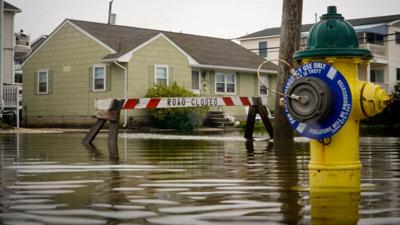

A fire hydrant and and "road closed" sign in water in Ocean City following a nor’easter on September 27.
Flooding is a major issue in South Jersey, especially when strong storms bring heavy rain, high winds and high tides. The recent nor'easter from September 25 showed just how quickly flooding can become a problem for communities across the area.
Last month, streets along the Jersey Shore were covered with water, cars became stuck or even submerged, and beaches experienced significant erosion. In Atlantic City, flooding became especially serious around high tide, with water filling low-lying streets and reaching homes.
Many of the homes affected were not vacation properties but primary residences, including homes in low-income neighborhoods. For these residents, flooding is more than just an inconvenience; it can damage the places where they live and create expensive repairs that some families may struggle to afford.
When water gets inside a home, it can damage floors, walls, furniture, electrical systems, and personal belongings. It can also leave behind mold and other problems that can be expensive to fix. For families, a major flood can create problems that last long after the water goes away.
This article from South Jersey Climate News was published through the NJ News Commons, a collaborative network of digital news publishers in the state.
For South Jersey, understanding where flooding happens and making sure communities are prepared could help reduce some of the damage caused by future storms.
Qian He, a researcher and urban planner at Rowan University, studies how natural disasters such as hurricanes and flooding can affect communities. Her work focuses on coastal planning, housing, land use, and how communities can prepare for environmental changes. She is also one of the leaders involved in a research project supported by the National Science Foundation (NSF), which looks at flooding and how communities can better understand and prepare for its impacts.
"Families may have to pay for repairs, people may have trouble finding affordable housing, and communities may have to spend money repairing roads, but the people of the communities that are affected are the ones we are really trying to reach out to," He said.
One of the flooding issues He discussed is nuisance flooding, which happens when water covers streets, sidewalks, and other low-lying areas, sometimes even without a major storm. This type of flooding can happen during high tides and may not seem as serious as flooding from a hurricane or nor'easter, but it can still create problems for people living in these communities.
He's research assistant, Sean Olsece, pointed to Cape May County as one of the areas in South Jersey most impacted by flooding because of its geographic location. Cape May County's location makes it particularly vulnerable because it sits between the Atlantic Ocean and Delaware Bay. This means that communities can experience coastal flooding from different directions, making it harder to manage rising water levels during certain weather conditions.
He's work also connects to the bigger question of how South Jersey can prepare for future storms. With coastal communities facing heavy rain, high tides, and nuisance flooding, planning ahead can make a difference. Flooding should not only be looked at as a temporary problem that happens during a storm, her research shows; it can have longer-term effects on housing, communities, and the people who live there.
"South and Central Jersey have communities that are very vulnerable to flooding, so understanding those risks and preparing for them is going to be really important as we continue to see these storms," she said.
Cheng Zhang, an assistant professor in civil engineering at Rowan University, has studied flooding, extreme weather, and the effect of climate change on communities throughout the region. His research looks at how heavy rainfall can put pressure on infrastructure and create bigger problems for communities that already struggle with flooding.
Zhang explained that flooding is not simply about how much rain falls. Factors such as the rate of rainfall and whether a community's infrastructure can handle the effects of the storm can determine how serious the flooding becomes.
"Sometimes it's not just about the amount of rain," Zhang said. "It's about how quickly the water comes down and where that water has a place to go."
One example of this happened in September 2021, when the remnants of Hurricane Ida brought heavy rainfall and major flooding to parts of New Jersey, taking the lives of 30 residents. According to the National Weather Service, some areas of New Jersey received between 5 and 10 inches of rain during the storm, with much of it falling in just a few hours.
In Manville borough in Somerset County, the flooding became especially serious as the Raritan and Millstone rivers overflowed. Streets were covered in water, homes were damaged, and some residents were forced to leave their homes. The flooding also led to gas explosions that destroyed several buildings. For many families, the damage did not end when the water went away.
The effects of Hurricane Ida show how quickly heavy rainfall can overwhelm communities, even in places like Manville that are not located along the Jersey Shore. What happened in Manville is another example of why flooding is not only a coastal problem and why communities throughout New Jersey need to prepare for major storms.
When flooding happens, people see the results: flooded streets, overflowing storm drains, and water collecting where it normally shouldn't. But there is a much bigger problem underneath of this damage. Zhang's research has looked at how flooding can affect other important infrastructure in South Jersey, including landfills and wastewater treatment facilities.
"We have to look at the bigger picture," he said. "How do we prepare our communities for these events before they happen?"
Another example from Hurricane Ida demonstrated how flooding in areas containing hazardous materials in New Jersey can threaten communities. In Bridgewater, the American Cyanamid Superfund site experienced major flooding after the Raritan River rose to dangerous levels. The site contains contaminated areas that require environmental cleanup, raising concerns about what could happen when floodwater reaches these locations.
According to the U.S. Environmental Protection Agency, flooding at the site reached levels higher than those recorded during Hurricane Irene in 2011. However, flood protection improvements made before Ida helped keep the site's operations and groundwater treatment systems working. This strategy shows why preparing infrastructure before a major storm can make a difference, especially in areas where flooding could create additional environmental problems.
That raises a bigger question for South Jersey: What are communities and local officials willing to do to fix the problem? Flooding cannot just be treated as something that happens after a major storm. Storm drains, roads, drainage systems, and other infrastructure need to be considered before the next storm arrives.
Environmental Resolutions, Inc., based in Mount Laurel, is an engineering, environmental, planning, and surveying company that works with communities throughout New Jersey. The company works on everything from municipal engineering and water systems to stormwater management, flood mitigation, and drainage projects. ERI also works on localized flooding fixes, drainage studies, and upgrading older infrastructure to handle increased stormwater flows.
The thing that can make flooding worse is storm drains. Storm drains are supposed to help move rainwater away from streets, but when they are covered by leaves, dirt or other debris, water can build up faster. Before the nor'easter, Camden crews were clearing storm drains and removing debris to help prevent water from pooling in the streets.
Rakesh Darji, vice president and treasurer of ERI, works specifically in stormwater management, municipal engineering, and floodplain management. He is also a Certified Floodplain Manager and has worked on projects involving stormwater design and flood-hazard permitting.
Darji explained that fixing flooding starts with understanding where the water is coming from, where it is going, and whether the current infrastructure can handle it.
"You really have to look at the entire system," he said. "You have to understand where the water is coming from, where it is going, and what happens when you get a major storm. If the system is already overwhelmed, you have to look at what improvements can be made to give that water somewhere to go."
Darji explained that there is not one solution that will fix every flooding problem.
"Sometimes you can improve the drainage system, but you also have to look at other ways to manage that water before it becomes a problem," he said. "There are different things communities can do, whether that is upgrading older infrastructure or using different stormwater management practices to slow the water down and keep it from overwhelming the system."
One city that has already started taking steps to address flooding is Atlantic City. The city has invested millions of dollars into projects designed to improve drainage and protect neighborhoods from rising water. One of the biggest projects is the $22 million Baltic Avenue Canal restoration, which focuses on improving a drainage system that was originally built in 1912. The project includes new floodgates and pumping stations to help move stormwater out of neighborhoods before it becomes a bigger problem.
The canal helps drain about 775 acres of Atlantic City, including parts of Ducktown, Midtown, Westside and the Inlet neighborhoods. Six large pumps were added as part of the improvements to help remove water during major flooding events. These upgrades are important because many of these neighborhoods experience flooding during heavy rain and high tides. The goal is to reduce the amount of water collecting in streets and protect homes and businesses from future storms.
Atlantic City has also worked on replacing bulkheads, which are barriers built along the water to help protect nearby land from flooding and erosion. In July 2025, the city announced an $8.5 million bulkhead replacement project in the Chelsea neighborhood. The project includes replacing older bulkheads along the back bay and improving stormwater drainage. However, uncertainty surrounding federal funding and FEMA could make it harder for Atlantic City to continue some of its future flood protection projects.
Improving drainage systems, replacing older infrastructure, and finding funding for future projects are all important parts of preparing for flooding. Atlantic City's efforts also show that addressing flooding takes more than just cleaning up after a storm. It requires planning and investing in improvements before the next major storm arrives.


